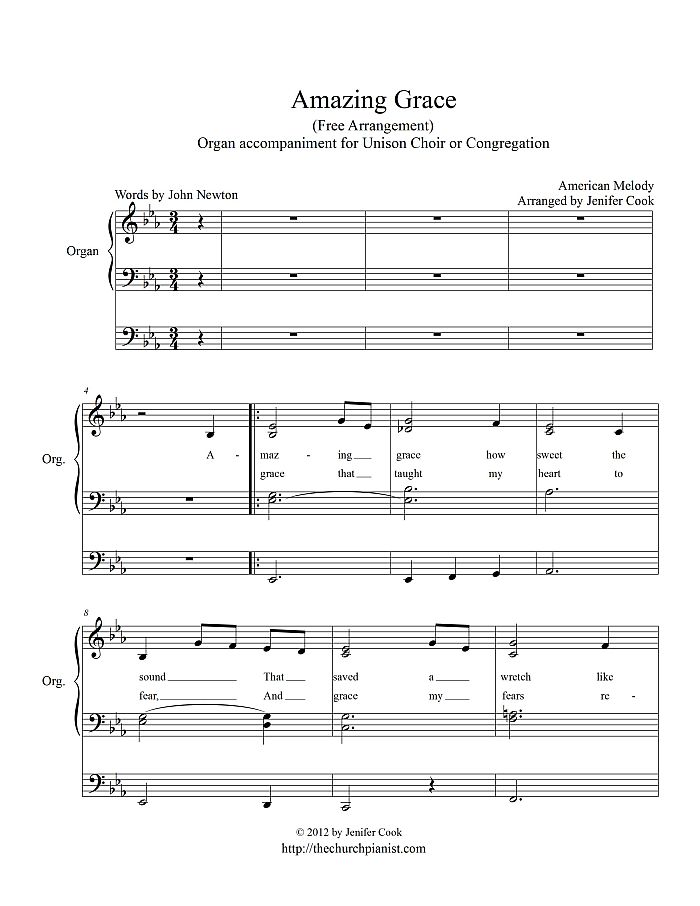
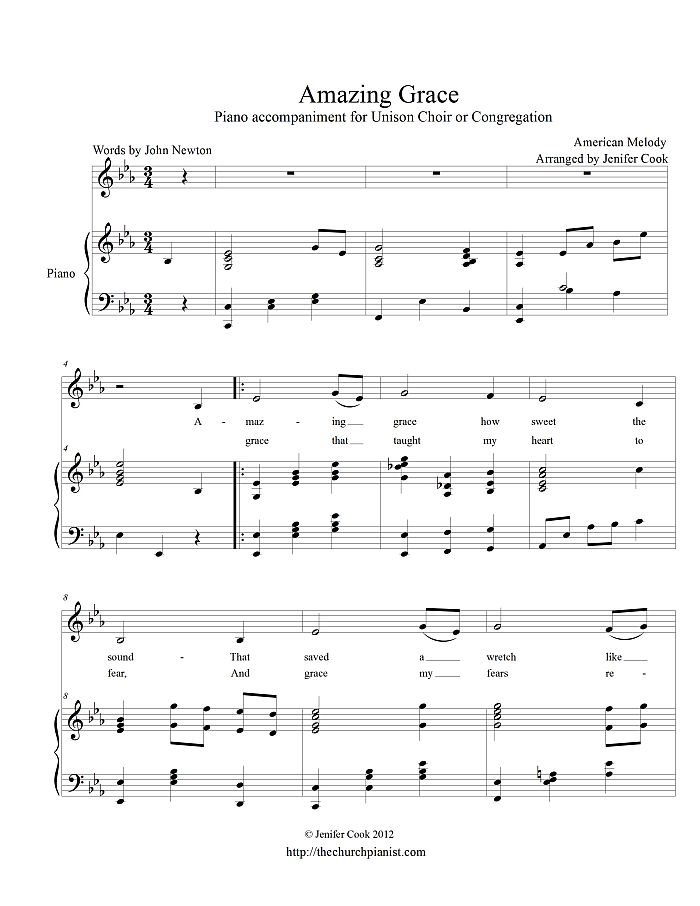
This free organ arrangement of “Amazing Grace” for unison congregation or choir goes with the piano arrangement of “Amazing Grace” which I recently published for FREE.
Please understand…I am not an organist and it’s my very first attempt at writing an organ arrangement!
I’m glad one of my readers pointed out the need for organists needing the same arrangement in order to prevent chord clashes…an excellent observation! Our church doesn’t have an organ…just two pianos (one being a digital).
I thoroughly enjoyed creating this organ arrangement!
Click here to download FREE organ arrangement of “Amazing Grace”
Amazing Grace: Complete Audio
You need to have the Audio Player Plugin installed to use this shortcode
Introducing…a free piano arrangement of Amazing Grace for unison choir or congregation. It’s nice to be able to sing parts but most congregations of small churches seem to sing unison.
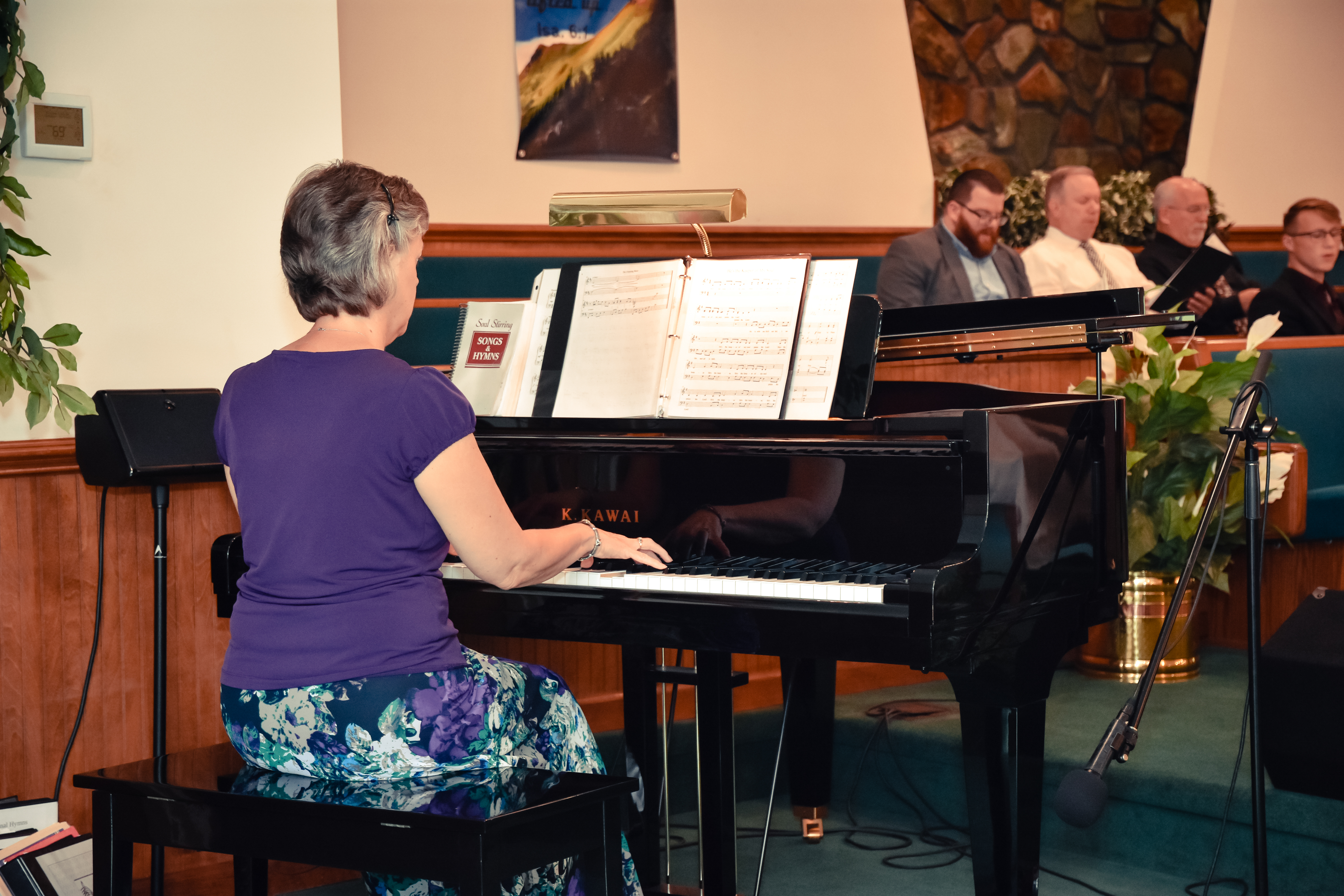
Church pianists can enliven hymns such as Amazing Grace by playing with mucho enthusiasm! I understand not every church pianist knows how to improvise from the hymnal. It took a lot of practice for me to feel comfortable adding unseen notes while playing from the hymnal.
Improvising tip: Grab an improvising idea from someone else’s arrangement and try applying to a similar congregational hymn with same time signature.
Stick with that one idea for a while until it becomes natural to use…then on to the next improvising idea!
Hope you enjoy this arrangement. Since most people are very familiar with this hymn, I took more liberty with the piano accompaniment.
Warning: This arrangement does not support the four-part style in the hymnal.
Question from a reader:
I love these ideas but at my church both piano and organ play. I find it hard to take any liberties since I am not playing alone. Any suggestions for those of us who would love to add flare to hymns but still have to keep the organist in mind?
Answer: (at least for this arrangement) I will soon provide a free organ arrangement of this particular version of Amazing Grace.
Audio: You need to have the Audio Player Plugin installed to use this shortcode
Extra tip: This arrangement could also be used as an offertory using the following suggestion: Allow a flute or violin to play the vocal score since the piano accompaniment doesn’t contain enough melody.
I love to sing “Amazing Grace”! It reminds me of when I accepted Christ as my Saviour at the age of 29.
A quick tip for church pianists on how to enrich congregational singing…
1. Start in a lower key. The congregation sings out better in lower keys…especially if you have a congregation like ours that mainly sings melody.
2. Modulate up a half or whole step higher on the final verse.
In the following video…we started in E flat major and ended in F Major.
The church pianist CAN add zest to congregational singing! Learn to play a hymn in different keys for added enrichment.
I will attempt to write out Amazing Grace in a user-friendly version for congregational piano accompaniment within the next two weeks and share for FREE! (transposed verse will be included)
If you are a church pianist or play specials in the church service…you know what it’s like to turn pages while playing an offertory or choir special.
You (maybe) can get by with page turns for a choir special… but not for an offertory.
How to turn pages without disrupting the flow of music? Two solutions come to mind that I have used: Find someone to turn pages or turn your own pages using the following tips:
1. Memorize a few measures before and after the page turns (very helpful!) Tip: Try highlighting the measure where you pick up reading after a page turn to avoid disorientation 🙂 Depending on the note content…it may be too tricky to turn a page a few measures before. In that case, I memorize a little more so I can turn the page at a more convenient spot.
2. Turn the page(s) with the hand that’s not playing the melody to maintain a logical flow
Face it…you may just have to miss a few notes with the non-melody hand to make this happen.
3. I also turn back the corner of each page…making the page easier to grab
*I have copied pages to avoid page turns but ONLY with special permission from the publisher; so as not to infringe on copyright laws. (I should probably devote an article on copyright laws).
If I have someone turn pages…I have them stand on my left side if at all possible…. so as not to block the congregation’s view of the person playing.
For those of us who’ve ever had “page turn” issues…I recommend the following video. I’m just glad the girls knew their parts real well…especially the girl on the left.
I couldn’t resist sharing the next gadget that would be heavenly for any pianist!
I honestly had to think REALLY hard to come up with some FRESH ideas…considering this particular hymn uses only three different chords…G, C, and D. (I wrote this in mind for congregational singing).
The following free pdf of “Wonderful Words of Life” contains ideas for one verse. The vocal score (melody only) is included as a guide for the church pianist.
Our church sings this hymn at a fairly peppy tempo…making for a simple, straightforward accompaniment. Adding too many notes to a fast tempo… would tend to drag the speed.
I will provide an audio below for the suggested speed of this piano accompaniment…when my computer and I can get along.
Special note: A slower tempo of this hymn would allow the pianist to add even more fill-ins! (another lesson)
One of my church pianist readers recently asked me for some help on measures 29 and 30 of the free piano arrangement for “The Old Rugged Cross”.
In measure #29…The right hand has to reposition on the second beat in order to compensate for the upcoming busy movement. I created a quickie video demonstrating a suggested fingering to make this area feel more comfortable to the hand.
Feel free to ask for any guidance or tips on this piece or any other arrangements I’ve written.
Church pianists find it an extra challenge when accompanying vocalists singing wordy hymns. Hymns such as: In the Garden, Wonderful Peace, Fill My Cup Lord,God Leads Us Along and No One Ever Cared for Me Like Jesus.
These wordy hymns are most effective when sung or played in a more conversational tone to avoid a mechanical reading style often heard in young ones when they are first learning to read. How to achieve a more conversational sound?
In 4/4 time…beats one and three are naturally stressed. Emphasizing these particular beats results in a more shapely tone…making the message flow in a more conversational tone.
Listen to the two accompaniment style excerpts in the video below to determine which style sounds more conversational.
“No One Ever Cared for Me Like Jesus”
*Editor notes:
Accompaniment pattern #1: I basically played every word of the song.
Accompaniment style #2: I used quarter note chords here and there to break up the repeated eighth note patterns..allowing the singer more ebb and flow of rhythm.
Special note: I sang the excerpt(s) in A Major on the video (due to my vocal range but the free pdf is a half step higher in B flat Major.
I would have loved to share the entire song…but this particular hymn is copyrighted. The “fair use” law allows me to share a small portion of a copyrighted song for educational purposes only.
(I think of a descant as a melody within a melody).
The descant is most effective when used only on the final verse of a hymn…creating an exciting climax! Usually a soprano or several sopranos sing the descant. If you don’t have the voices to support the descant, a solo instrument such as a flute or trumpet can play the descant part. Sometimes the piano can carry the descant part as well.
What’s really neat is when the whole choir sings a descant part on the final verse of a congregational hymn.
The video below contains a violin solo accompanied by the piano. Listen for the piano playing a descant part on the first and second chorus.
Free printable descant links below:
(the following links may contain music not in accordance with this site but still includes appropriate music for worship)
Here is the remainder of the free congregational piano arrangement… “I Love to Tell the Story”.
I enjoy playing for congregational singing because that’s when I can “go outside the box” and play more than just melody.
Having a knowledge of chord theory opens the door for so much creativity! For example…in measure #12…I knew the chord for the measure was a B Major chord…so I just added moving 3rds in the right hand for a fill-in. I used the same idea again in measure #18.
I’ll point out one more neat idea in measure #22. Notice the half note octave “A” in the left hand. An “a” minor chord can replace a C Major chord because they both have two notes in common….”C and E”.
A “G” from a “C” chord also fits in an “a” minor 7th chord. Now if you know your theory….that will make sense. Note members for the “a” minor 7th = ACEG
I challenge all church pianists to brush up on their scales and chord theory. I found an excellent, practical music theory book that has been so helpful to me. Stay tuned…for my next article on this VERY easy-to-understand book!
“I Love to Tell the Story” has always been a favorite of mine. The story to this wonderful hymn can be found at cyberhymnal.org. This particular hymn came from a rather long poem. The first part of the poem contained at least fifty stanzas!
I’m sharing a free congregational piano arrangement of “I Love to Tell the Story” for the advanced church pianist. This free arrangement contains a lot of full chords which is necessary for supporting congregational singing.
I apologize for not posting as often but circumstances haven’t allowed me to do so. I always hearing from my readers. Thanks so much for your encouragement! I love to hear how the site has been a help to you. That’s what keeps me going 🙂