The Love of God Advanced Piano Solo

August 14th, 2014

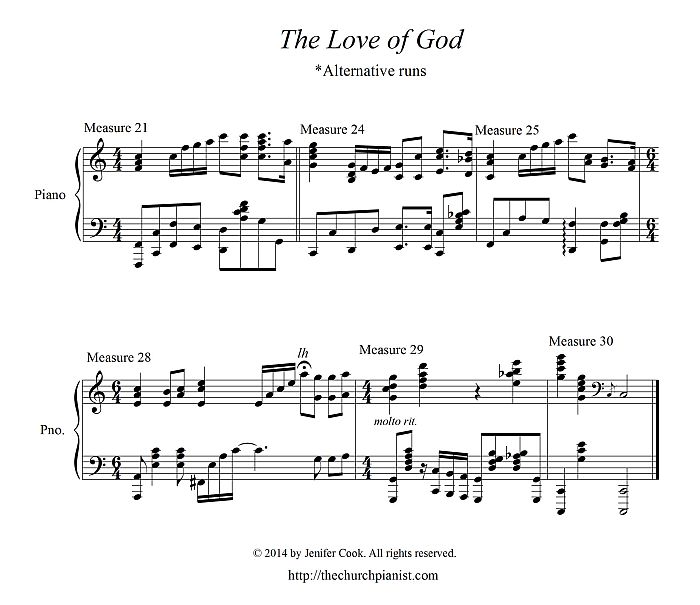
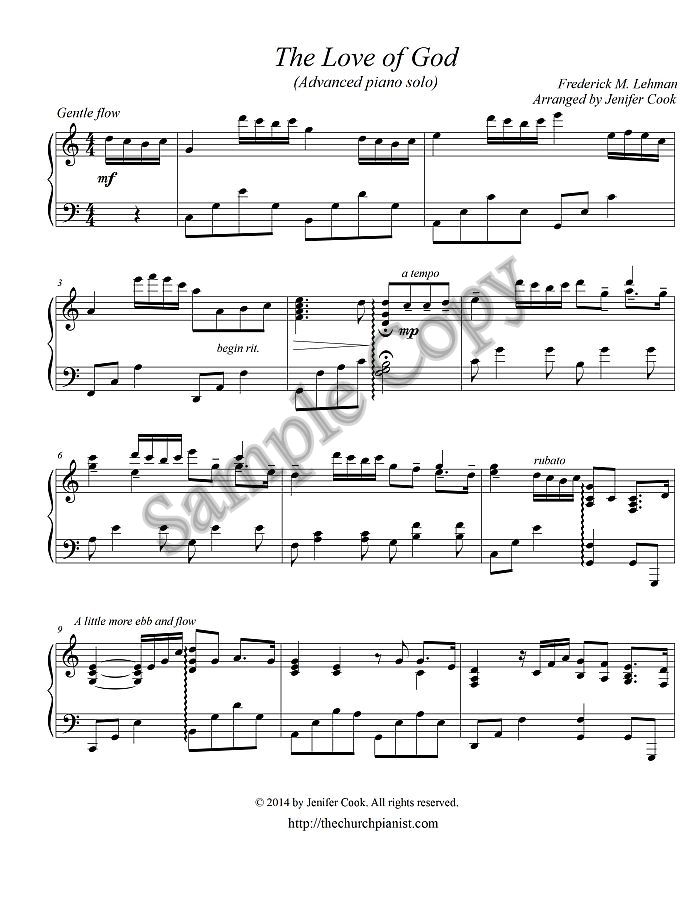
Finally! The Love of God advanced piano solo is complete! I wrestled with the ending for quite a while.

Thanks to Hannah Myers, one of my advanced students, for giving some excellent suggestions!

This hymn is one of my favorites.  Have you heard the story behind the writing of verse three?  Very touching!  I will have to share it soon 🙂

Just wanted to share the video of my completed arrangement for The Love of God.  Sheet music coming tomorrow!

Augmented Examples for I to IV Chord Progression

August 8th, 2014

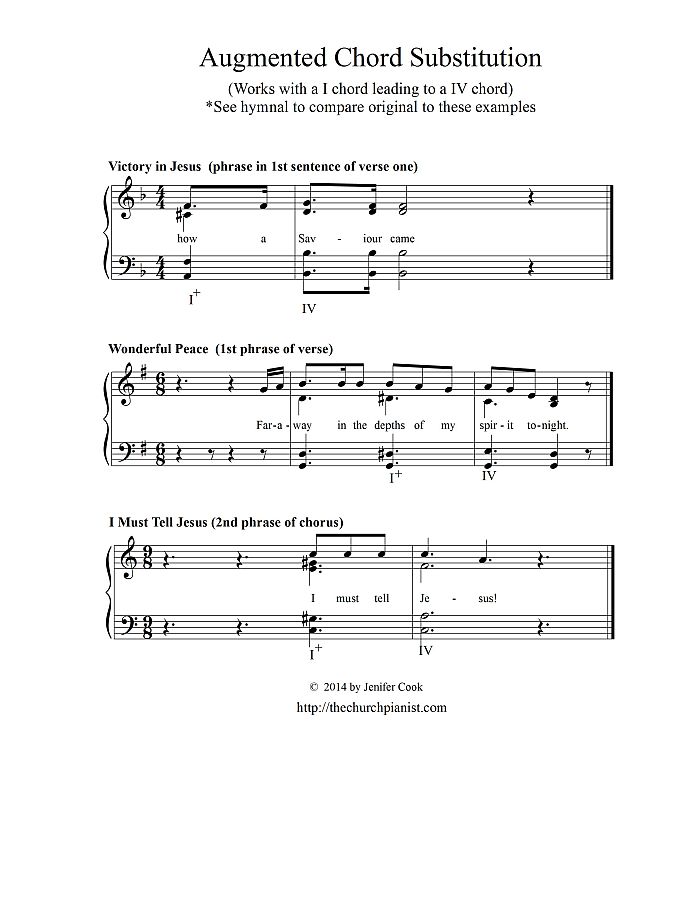
*Click here to read introduction of diminished and augmented chords to understand the following free handout on augmented examples in hymns.


Explanation of the following visual:

When progressing from a I to IV chord…raise the 5th note of the I chord (G) to (G#) making it an augmented I chord which strongly leads into a IV chord.


Click here to download a free pdf of the Augmented  Chord Substitution Sheet


Augmented-examples-I-IV

The Augmented & Diminished Chord: Introduction

August 2nd, 2014

  “Diminish” (verb) to make smaller vs. “Augment” (verb) to make larger

A diminished chord is a minor chord with a lowered 5th

Example:  C Eb Gb   Or expressed as: C°

Suggested role of the diminished chord: creates suspense

An augmented chord is a major chord with a raised 5th

Example:  C E G#    Or expressed as:  C+

Suggested role of the augmented chord: generates amazement; surprise; anticipation

The diminished or augmented chord is not found within the scale. The pianist must alter the notes of a chord to create either one of these chords.

~ ~ ~ ~ ~ ~ ~ ~ ~ ~ ~ ~ ~ ~ ~ ~ ~ ~ ~ ~ ~ ~ ~ ~ ~ ~ ~ ~

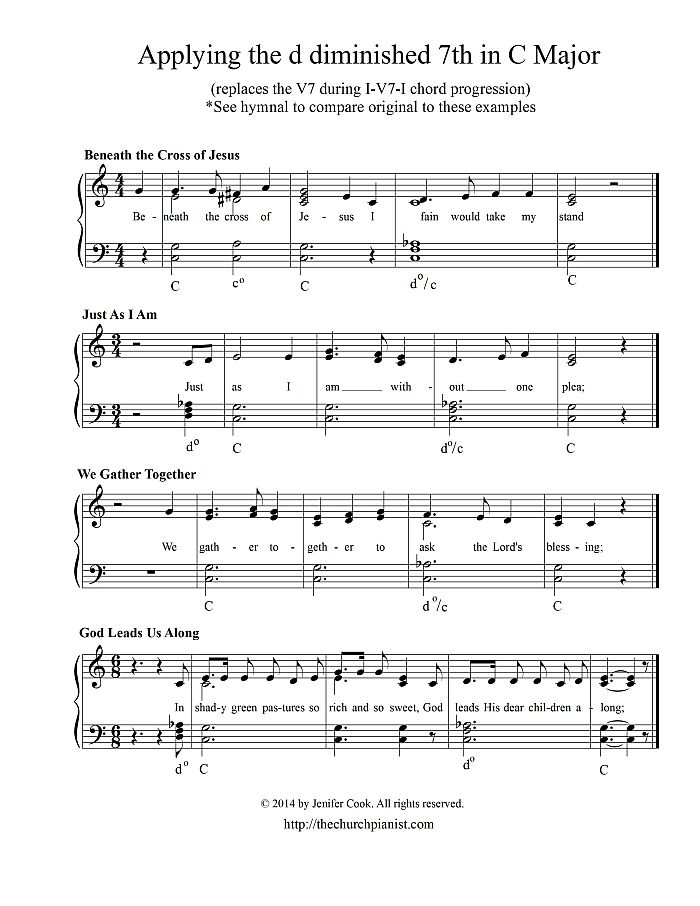
Visual examples of the d diminished in the key of C Major

d diminished = D F A flat

*diminished 7ths are more common; create fuller sound

d diminished 7th = D F A flat C

The symbol ° after the chord letter name… represents diminished chord

The / separates the diminished chord from the bass note (the slash is used when the bass note is NOT the root note of the diminished chord.)

Click here to download visual example for application of the d diminished 7th chord.

Application-of-D-dminished-7th-in-C-Major

Special note:  Yes, I should have included a “slash” indicating the “C” as the bass note for the last example on the word “leads”.  Hope you caught it!  🙂

 I will share augmented examples in the next article asap!

These diminished chord examples are just a tip of the iceberg! 

This lesson does not contain a thorough list of diminished chord possibilities  within a key/scale.


Free Prelude Transitions for Church Pianists!

July 29th, 2014

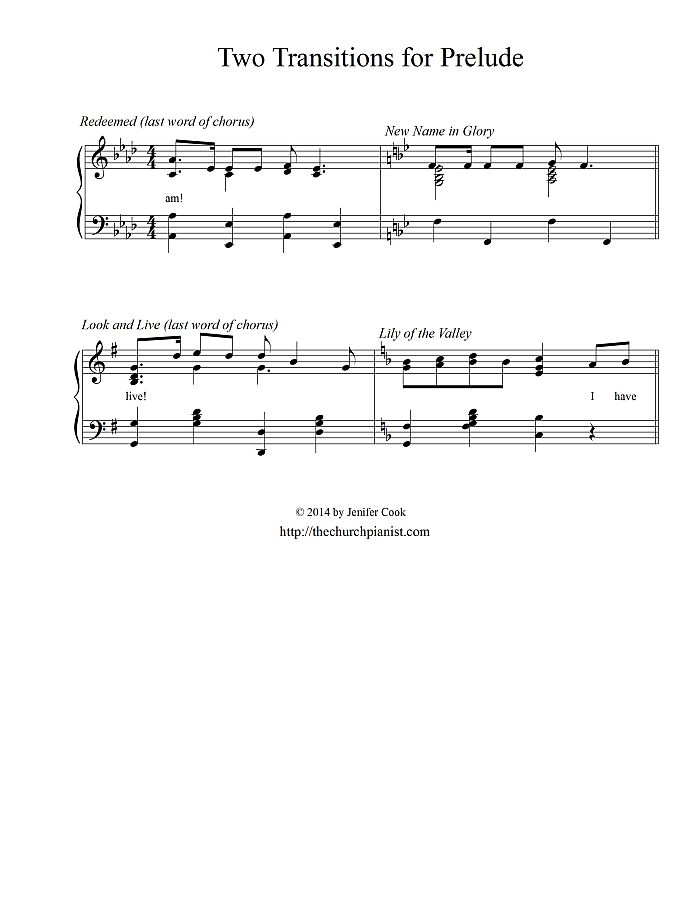
Just wanted to share a couple of spontaneous prelude transitions that I created today for one of my hymn playing students during their lesson.

She’s wanting more help in the area of prelude transitions…and needed to see examples for transition ideas.

Hope they’re a help to other church pianists too!

Prelude Transition tips:

When creating a prelude transition consider the following:

1.  The time signature you’re coming from and going to

2.  The key signature you’re coming from and going to

3.  Mood of approaching song

4.  Add a ritard toward end of first song before the transition to allow breathing space for the player and listeners.

Prelude-Transitions-NEW

What I’m Working On…

July 24th, 2014

coming_soon

What are diminished and augmented chords?  Where can I use them? The first article on diminished and augmented chords will answer these questions.

The other post I’m creating deals with tips for choosing vocal solos for the male voice.  I enjoy the challenge of looking for solos that fit a certain person’s vocal range/ability.  Singing a song that fits the singer’s range allows for a more positive experience for the soloist as well as the listeners 😉

It’s our responsibility as Christians to be as effective as we can to carry God’s message through whatever means possible and that includes singing.

Looking forward to sharing more soon!

Youtube Recordings for The Piano Invitation Collection…

July 21st, 2014

News for my church pianist readers: I’ve been creating video recordings of The Piano Invitation Collection and publishing them on my youtube channel.


The Love of God (finished handwritten copy!)

July 19th, 2014


writing_pen

Wow!  I just finished writing the hand-written copy for The Love of God.

I just started it yesterday!  That doesn’t happen too often.  Thank you Lord!

Now…to input it into Finale which takes at least three hours to complete along with layout details.

I  allow several days for the piece to settle before I finalize it.  Reviewing the piece after a day or so allows me the chance to catch mistakes I may not have caught otherwise or…discover a different chord path altogether, etc.

Current Writing Project: The Love of God (Advanced piano solo)

July 19th, 2014

curly-staff-red-notes

Yesterday, I started a new advanced piano solo arrangement of “The Love of God”.

I have struggled in the past trying to write a piano solo version of The Love of God. Several years ago I created a vocal trio with piano accompaniment for this hymn.  It was easier to write since I didn’t have to stick to the melody.

As I sat at the piano yesterday…a motive (a melodic pattern)… just came to me which you will hear in the introduction. I tried to stay true to the style of the song so as not to distract from the message.

This particular arrangement will be written in my “free style” of playing which I enjoy the most. ( no structure!)  yay!  Although structure does make the arrangement more user-friendly.

Thanks to many such as Ashley & Karen who have requested that I write an arrangement for The Love of God.

The Love of God (audio sample)


You need to have the Audio Player Plugin installed to use this shortcode

Diatonic Chord Substitution Examples: FREE DOWNLOAD

July 17th, 2014

As promised,  here are a couple more examples of a diatonic chord substitution.  (Link to FREE download at bottom of this article.)

Diatonic-Chord-Substitution-Examples


Click here to download your FREE copy of the diatonic chord substitution examples.


Chord Substitutions

July 10th, 2014

wavy staff with colored notes

Church pianists enjoying bringing hymns to life by adding different chords!  A recent question from one of my readers has created the perfect opportunity for me to share tips on chord substitutions….a topic I’ve been wanting to deal with for quite some time.  Chord substitutions can add such color to a song!  It’s a very B-R-O-A-D topic; meaning….there’s an endless supply of chord possibilities in any given key!

Reader’s Question:

“I have been using various resources trying to learn more about theory, but I haven’t found any that go beyond a basic level.

For example, I know what augmented and diminished chords are, but I don’t know how to use them or how they fit into functional harmony. In analyzing your arrangements, I have noticed you use a lot of different kinds of chords, such as chords with altered bass notes or a I-ii half diminished-I-etc. progression for introductions.

How did you learn how to use all these? Do you have any recommendations for resources that would teach me more? Any advice would be appreciated!”

Ashley


Hi Ashley,

How did I learn to use different chords from the written music?  You won’t like my answer 😉    I play them by ear…basically whatever sounds right. I do know chord theory but don’t think about theory application when playing….I just….play 😉  (Music writer’s confession: I don’t claim to be an expert theorist.)

For everyone’s benefit…the “different” chords we’re discussing are called chord substitutions. A chord substitution occurs when replacing a chord with a different chord.

Easiest Chord Substitution for Starters…

To replace a major chord within a key…use the chord a 3rd above or below the root note of a major chord.  (The major chords within any key is the I, IV and V).

The I chord in the key of C Major is the C chord (CEG).  Now, what note is a 3rd above CE…so the e minor chord (EGB) within the C scale can be used as a substitution as long as it “sounds” good within the occurring chord path (progression) of the song.  Count a 3rd below C and you find A.  The A minor chord (ACE)  is the second choice for a C major chord substitution.

Two observations about these two chord substitution choices:

1. They’re both minor

2.  They each have two notes in common with the chord being replaced

There are other types of chord substitutions but wanted to start with the easiest kind.

Extra Information:

1.The chord substitution just described above  (3rd above or 3rd below) is called the Diatonic Substitution. A diatonic chord substitution occurs when using different notes within a scale. It’s the most natural form of chord substitution because no note alterations take place; just using what ingredients are already available within that key 😉

2. The key signature and melody of any song dictates what chord(s) can be used.

 ~~Next article will show examples of the Diatonic chord substitution~~

Special Note!

Special Note!

Great theory reference book:  “The Complete Idiot’s Guide toMusic Theory”

The-Complete-Idiots-Guide-to-Music-Theory


Related article on Chord Substitutions


Search Site
Article Categories