Archive for the ‘Technique’ Category
How to Play Fast Arpeggios
Wednesday, August 15th, 2012An arpeggio is a broken chord. I like to use fast arpeggios in my hymn arrangements. So…how do I determine where to place a fast broken arpeggio? Anywhere a word can be stretched (broadened) or held if you were singing the hymn.
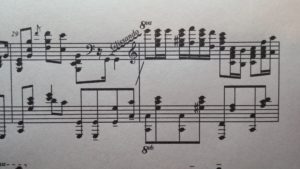
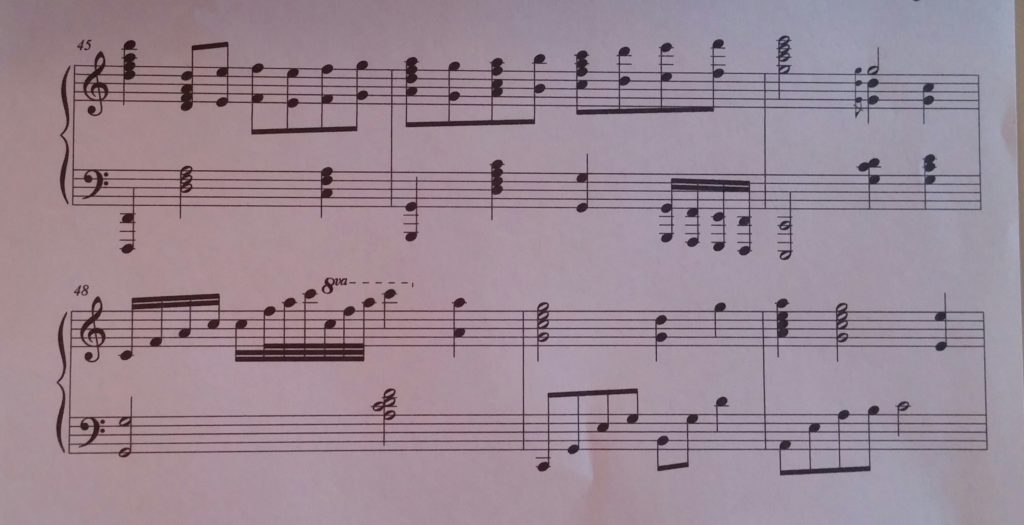
One of my free piano hymn arrangements entitled “What a Friend We Have in Jesus” contains a fast arpeggio on the second page. (Shown below)
This fast arpeggio consists of 12 notes. If you look closely, you’ll notice that I played 3 groups of one-octave arpeggios within the 12 note passage. Each group has four notes beginning and ending with note “G”.
I’m basically using a g minor one-octave arpeggio made up of the notes: G-Bflat-D-G
How to finger this? Use right hand thumb (of course) to start each group. For each group use the following fingering: 1 2 3 5
To properly blend this run into the arrangement…emphasize the right thumb at the beginning of the first group only; allowing the hand to relax and glide across the fast arpeggios in an even rhythmic flow. How to do this? Practice s-l-o-w
Careful not to play SO fast that it sounds “thrown in” …causing an interruption in the flow of thought.
Slow Motion Demo
Now…for the complete arrangement at regular tempo…
Fingering Tip for The Old Rugged Cross (free piano arrangement)
Friday, August 3rd, 2012One of my church pianist readers recently asked me for some help on measures 29 and 30 of the free piano arrangement for “The Old Rugged Cross”.
In measure #29…The right hand has to reposition on the second beat in order to compensate for the upcoming busy movement. I created a quickie video demonstrating a suggested fingering to make this area feel more comfortable to the hand.
Feel free to ask for any guidance or tips on this piece or any other arrangements I’ve written.
Glissando Tips
Tuesday, May 22nd, 2012One of my church pianist readers recently requested that I provide some helpful tips on how to play glissandos.
One of the trickiest technical moves in my How Great Thou Art piano arrangement is the glissando found on page four. (Shown below)
Glissando Tips
1. Notice the three tenuto (line marks) under the left hand in measure 29. These marks are pointing out the melody for the words “…then sings my…”. Emphasize the melody and keep the glissando volume in the background (little softer than left hand).
2. The right hand begins the glissando with the index finger immediately after the left hand plays the G octave with the first tenuto (line) mark. (It happens to be the same G as the left thumb just finished playing in the G octave).
3. Start the glissando with your right hand index finger…flipping the right hand over after the index finger starts. The index finger and 3rd finger will glide across the keys in an upside down, horizontal position. Once the index finger begins…the third finger will carry the brunt of the notes as you glide upward. The index finger will act more as a support and guide for the third finger. Just remember….the third finger is longer so it naturally has better contact of the keys.
4. Word of caution to church pianists: Glide across keys in a lightweight; relaxed fashion to avoid sore fingers
Visual Tips for the Glissando in How Great Thou Art
Church Pianist Tip: Rock of Ages with “Weighty Chords”
Thursday, March 1st, 2012Recently, I’ve been working on an arrangement of “Rock of Ages”. The introduction contains what I call “weighty chords”…chords with three or more notes. Thus, the following tip…
Scenario: A pianist sees a chord with three or more notes…(brain computes)…HEAVY touch! Your brain thinks….I can’t possibly mash all those notes down at once without attacking them
Word of caution: Relax and apply gentle even pressure as though you’re lightly kneading dough… to avoid a “chunky” or “weighted” sound…especially when the full chords occur on the weak beats.
For example, in 4/4 time, the 1st and 3rd beats are naturally accented. Therefore the 2nd and 4th beats are weaker. In 3/4 time…only the first beat of each measure receives the accent. Why? To produce a more shapely rhythm and to avoid a mechanical/laboured sound.
The following excerpt is from an arrangement that will be included in a “Funeral Collection” which I hope to finish within the next several months. Notice the full chords in the left hand. I will give a brief demonstration of a suggested way to interpret these chords…fighting against the natural tendency of “heavy hand” treatment.
Click here for: video clip of following example
Best and Worst Ways of Practicing
Saturday, March 5th, 2011Good practicing habits are necesscary for all pianists…if they want to progress and sound prepared.
I stumbled across an excellent article on the best and worst ways to practice located on the website entitled Piano Perspectives.
Click here to read Best and Worst Ways of Practicing. Decide which list you belong to.
The Church Pianist: Runs in Hymns (example three)
Thursday, September 9th, 2010

*(You may want to print the “Runs in Hymns example three” page below to have on hand as you read the following information)
I enjoy using what I call “cluster runs” in hymnplaying. It’s just a cluster of notes (close together) played in a rapid broken-chord pattern. I just repeat the same four notes up the piano. Runs can be added almost anywhere as long as they fit the flow of the hymn. The run needs to sound like it belongs in the arrangement…not just thrown in as an afterthought.
The following example illustrates the use of the “cluster run” in the hymn “Throw Out the Lifeline”. The cluster run begins on the word “someone”. Just use your right thumb to start each set of four notes. For each group of 4 notes…I use the 1st, 2nd, 3rd and 4th finger.
Emphasize (stress) the first note of each 4 notes to create a more shapely tone…making the run blend into the piece.
Runs- in- Hymns- example -three
Audio of Runs in Hymns (example three)
One of my latest arrangements uses this cluster run in most of the chorus of “The Light of the World is Jesus”. The sample audio on this link contains the chorus with the cluster runs.
The Church Pianist: Adding Runs to Hymns (example #2 explanation)
Wednesday, September 1st, 2010Example #2 for Adding Runs in Hymns
Explanation of example #2 in adding runs to hymns:
(Click on image for a clearer view)
This run created a nice fill-in where normally a dotted half note occured on the word: “Thee”. In the original version, the G chord lasted for the entire last measure of the verse for the words: “Thee….Draw me” I added a D (7) chord on the 3rd beat of that measure for chord variety.
*Upcoming article: Longer example with run in middle of a sentence with user friendly fingering! I call them cluster runs
The Church Pianist: Adding Runs to Hymns (Example #1)
Saturday, August 14th, 2010I enjoy adding runs to hymns. A lot of pianists have asked me the following questions about runs over the years:
1. Where can I add a run?
2. What notes do I use?
3. Do I start the run on the word or after the word?
4. How do I make the run sound like it fits?
5. What fingering do I use?
6. Do I use one or two hands for this run?
Excellent questions! I will attempt to answer these questions as I go through this series of articles on adding runs to hymns.
Runs consist of either arpeggios (broken chords) or scales. Ew….got to know your theory! (Another lesson)
1. Arpeggios look like this… (notes on treble staff below)

*Special note: Did you notice this particular arpeggio is the second inversion of a C chord with a passing tone sprinkled in? Hmm…I feel more theory lessons coming. That’s ok… a little at a time, right?!
*I’ll show an example of a scale used as a run in upcoming articles.
Some pianists find “adding their own runs” to hymns or playing runs in hymn arrangements to be rather difficult. Let me give you a helpful suggestion…isolate the run…turn it into a technical exercise and learn it well.
When playing runs or anything else for that matter, it is extremely important to use correct fingering. Many church pianists never had the proper training in this area…making it difficult for them to play in a smooth style. It’s ok..not your fault. I’ll provide fingering suggestions on today’s example of a run…to help you produce a flowing style. This first example will use a right hand arpeggio in an octave format (spread).
Editor notes for today’s example:
The example contains the final phrase of Trust and Obey, written in congregational style.
The run occurs on the second syllable of the word “Je-sus”
Notice the ritarando marking (rit.) starting ahead of the run… so the run won’t sound rushed as though it was just carelessly thrown in. I’ll provide an audio link for this example.
The measure containing the run has an extra beat to allow time for the run. (This isn’t always necessary)
Click on the following…Runs in Hymns (Example #1)
Link: Adding runs to hymns Example Two
The Church Pianist: Scales in Hymns (Part Four)
Friday, April 23rd, 2010To start with…I will show you a page of hymn arrangement samples containing scales. Scales are used to embellish a melody or simply as a fill-in. In the following examples…both functions are utlizied.
Editor notes for Scale Variations in Hymns
Count Your Blessings (the opening scale is added as extra filler to an introduction)
Jesus Loves Me (the scale creates a nice dress-up for the melody)
Let the Lower Lights Be Burning (this scale creates a nice filler on the syllable “more” and blends into the next two words “But to”)
Editor Notes for final page “Practical Scale Exercises”
When trying to master technical passages in hymn arrangements…I will isolate the passage and master it. Sometimes I create or embellish upon the passage making it more fun to practice. Hope the following scale exercises will stimulate other church pianist’s creativity.