Archive for the ‘improvising hymns’ Category

When the Roll is Called Up Yonder (improvising idea)

Sunday, January 15th, 2012

All church pianists understand there are those hymns that just need a little dress-up to bring them to life!  One of those such hymns is When the Roll is Called Up Yonder. Why the need for a dress-up?  Because there are a lot of repeated chords throughout the entire hymn.  What can be done to make this hymn sound more interesting?  Replace the repetitive bass line with a simple improvising idea.

When-the-Roll-simple-dressup-chorus

Click on the following song title to see this improvising idea put to use. The pattern can be seen in the first few measures.

When the Roll is Called Up Yonder (part of chorus)  Intermediate version

For those of you at a more advanced level..you’ll find a free sample below of what I would play to accompany congregational singing. (I transferred the stepping down pattern to the right hand for the first phrase of the chorus.

When the Roll is Called Up Yonder (part of chorus) Advanced version


The Church Pianist: Improvising Tip

Wednesday, November 9th, 2011

 Over the past ten years, I’ve learned ALOT of theory amidst many hours of  composing hymn arrangements.  There’s so much more I need to learn but I just pick up tips here and there and put them to use.  Now…I’ll share one of those tips with you.

The following improvising tip has made a difference in my hymnplaying; creating a more open, balanced sound.  I apply this tip to my congregational and solo playing.

The following hymn example contains “Come Thou Fount” in D major and the improvising tip.

Click here to download “Come Thou Fount” with improvising tip.

Just for fun: After playing  the above improvised example…add the 3rd of the chord in the right hand too…just to hear the difference.

Free Sacred Piano Arrangement: The Rest of Blessed Assurance

Saturday, October 22nd, 2011

Here is the rest of the free piano arrangement of “Blessed Assurance”. The complete arrangement contains two verses and choruses.  The second verse is actually arranged for the last verse of “Blessed Assurance”.

Explanation of my note on page three:  “Watch the director closely here”  is meant for the final verse.  Of course the church pianist should watch the director through the entire song but especially where a slow down occurs. Many directors begin to broaden the tempo at this part of the hymn…making it easier for the church pianist to throw in some busy note passages such as you see in the right hand on the words: “Sa-viour” and “long”.   Adding extra notes helps to maintain a  steady tempo during slower sections.

Click here for free sacred piano arrangement of “Blessed Assurance” page two and three

Click here for “Blessed Assurance” page one

Keep in mind…every church sings a different tempo…making the accompaniment feel SO different.

Blessed Assurance audio: 

Audio clip: Adobe Flash Player (version 9 or above) is required to play this audio clip. Download the latest version here. You also need to have JavaScript enabled in your browser.

Free Sacred Piano Arrangement: Blessed Assurance (page one)

Sunday, October 16th, 2011

Since believing on Jesus Christ at the age of 29…I can truly say: “Blessed Assurance Jesus is Mine”.  This became one of my favorite hymns after becoming a Christian.

Shortly after being saved I arranged an offertory that included: “Blessed Assurance, Saved by the Blood and Since Jesus Came Into My Heart”.  I will have to write it out in my (ha ha) spare time.

This free sacred piano arrangement of “Blessed Assurance”  is a result of preparing several of our own soon-to-be church pianists to play for congregational singing.  We now have a rotational schedule for our intermediate to advanced pianists to allow them to play for our congregational singing.  It’s exciting to see them gain experience to better equip them for serving the Lord.

Click here for the free sacred piano arrangment of “Blessed Assurance” page one.

I’ll share the rest of this free arrangement in the next article.


How to Play Hymns & Gospel Songs in an Evangelistic Style

Tuesday, October 11th, 2011

How to Play Hymns & Gospel Songs Instructional Book

Just discovered a practical instructional book on  improvising hymns found on Alfred Publishing’s site.

This book is a great starter for the intermediate pianist who wants to improvise from the church hymnal.  The pianist will learn how to do the following:

*Add tenor to the right hand

*Double the bass note

*A couple of easy-to-learn  left hand fill-in ideas

*PLUS…a collection of hymns already arranged for the intermediate church pianist using the improvising ideas that are taught in the book.

Click on the following book title to view the book and sample pages!

“How to Play Hymns & Gospel Songs in an Evangelistic Style”

Improvising Hymns: Lesson Two

Sunday, October 9th, 2011

Click here to download worksheet before watching video for “Improvising Hymns” Lesson Two 

Have a pencil handy!

The following short video tutorial on improvising hymns is geared to the beginning church pianist.  Playing straight from the church hymnal can sound rather plain. Learning how to dress up the hymns adds a new dimension of sound! This lesson gives some simple left hand fill in ideas for the first line of “When I Survey the Wondrous Cross”.

Special clarification about the theory rule mentioned in this lesson concerning omitting the 3rd of the chord…The 3rd can be omitted from either hand.   Wait until you see the video below to understand this explanation :)

The next video tutorial will reveal more improvising ideas for “When I Survey the Wondrous Cross”.

Click here to see My First Improvising Lesson

Free Improvising Ideas: Count Your Blessings (congregational style)

Sunday, October 2nd, 2011

The hymn “Count Your Blessings” carries a great message in song but contains frequent repetitive notes providing a rather plain accompaniment for the average church pianist

Free Improvising Ideas for Count Your Blessings (congregational style)

Key of D Major

1. Use alternate bass movement (see measure #2) LH beat one…I played an ‘A’ rather than ‘D’

2. Measure #1 and #5, beat one ( no need to play every word) when playing congregational style; allows more ease of movement for the pianist.

3. The four note RH chords provide support to the singers.

4. Measure #6, notice the contrary octave movement between the hands for variety.

    *Contrary movement between both hands always adds a nice touch of spice :)

Click here to download Free Improvising Ideas for Count Your Blessings (congregational style)

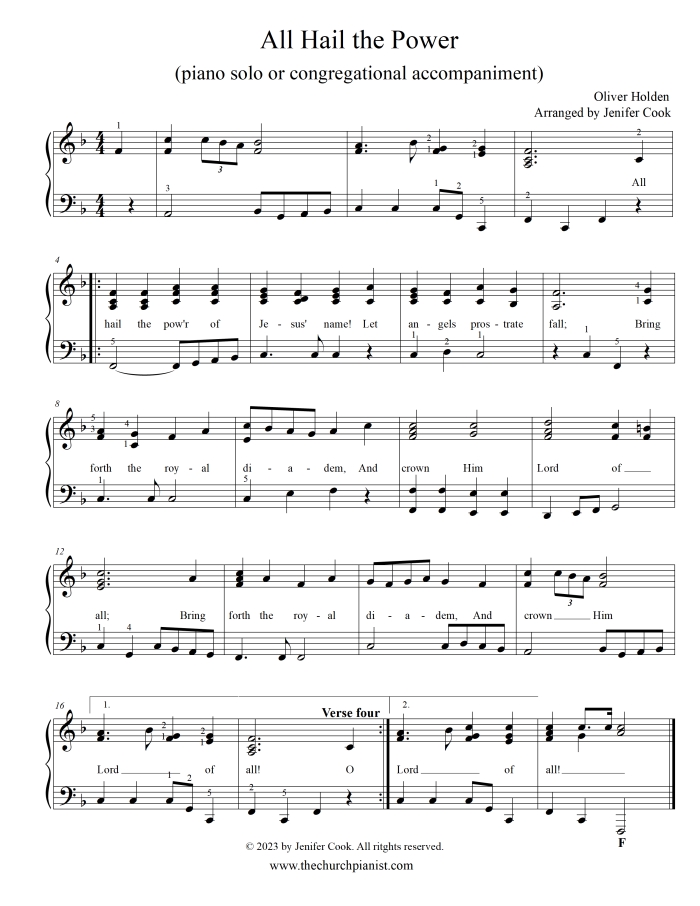
Free Piano Arrangement: All Hail the Power (page two)

Sunday, September 18th, 2011

I was able to finish page two of “All Hail the Power” tonight even after a busy but good week of revival at our church.   I will try to share some music highlights of our week sometime soon.

In my next article…I ‘ll share editor notes along with an audio of this free piano arrangement for “All Hail the Power” congregational accompaniment.

Click here to download page two of “All Hail the Power” free congregational accompaniment piano arrangement.

Click here for page one of “All Hail the Power”

Lesson One: The II 7 Chord Substitution

Wednesday, August 17th, 2011

A reader writes…

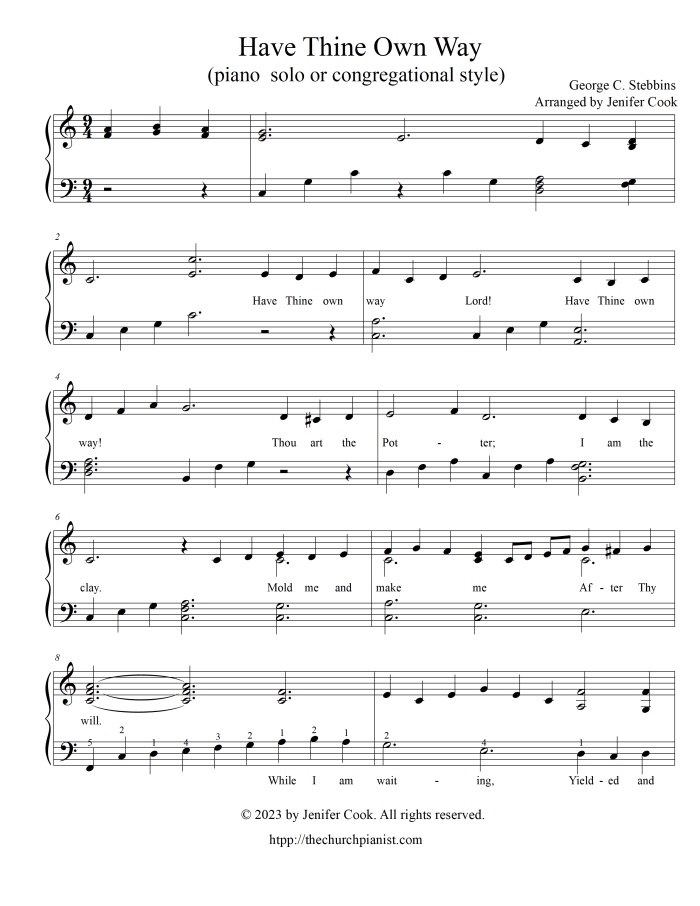
I’ve printed your “Have Thine Own Way, Lord”.  How did you know to put a F7 on the 2nd “own” in the first  full measure….
Is there a process of knowing what chords are to be uses as substitution and when to use them?
 
~Elise~
 

Fortunately…yes!  :)   There’s an endless supply of chord substitutions that can be used…depending on the initial chord scenario.

To begin with, I’ll apply this II 7 chord substitution to  the key of C Major for easier application. (Otherwise, it’s like teaching a beginner to play Moonlight Sonata at his first lesson)

So…what’s a II chord?!  In simple terms…it’s an altered chord.  Normally, the second chord in any major key is a minor chord…thus marked in lowercase roman numerals…ii.  For example, in the key of C Major…the ii chord is D-F-A.  (D is the second note in the key of C Major which gives the chord its number).   But…we can alter the chord (making it a major chord) by raising the middle note of the chord (the note F to an F sharp). * See example below

Now…to create the II 7 chord…just add the 7th note above the bottom note of the chord.      *See Example below

C Major ( how to create the II 7 chord)

Chord Scenario for the II 7 Chord Substitution:

1. When a I chord lasts for at least two or more beats leading into a V or V 7 chord lasting two or more beats. (to allow time for chords to develop) I’ve used the II 7 chord with less beats but in general…it’s best to allow enough beats for chords to sound like they belong and not just randomly thrown in.

In the examples below, I’ve included the vocal and piano score to reflect the changes made in the piano accompaniment.  *Reminder: chord substitutions clash with congregational singing due to the note changes.

I use chord substitutions when playing solo offertories, background music for invitation, prelude/postlude, communion and accompanying a vocal or instrumental soloist.


Examples in C Major (II 7 substitution)

~  ~  ~  ~  ~  ~  ~  ~  ~  ~  ~  ~  ~  ~  ~  ~  ~  ~  ~  ~  ~

 In Lesson Two, I’ll share more examples of this II7 chord substitution… including “Have Thine Own Way”.

*Please feel free to ask questions.


Upcoming Article: Substituting the I Chord with the II7 Chord

Tuesday, August 16th, 2011

Have _Thine _Own_ WayA reader recently asked me how I knew to use a certain chord substitution in one of my free arrangements “Have Thine Own Way”.

My first answer would be…I just thought it sounded nice.  But…unfortunately that’s NOT the best answer.  I hope to explain it in such a way that the average church pianist can take and apply this chord  substitution on their own.

Looking forward to posting this article soon!

Christmas CD
Simply Christmas CD *Available as hard copy
Custom Search
  • Article Categories
    Store Discount!
    15% discount on purchases greater than $15. Use coupon code: FERMATA