Archive for the ‘Miscellaneous tips’ Category

The Church Pianist: The Importance of Scales

Thursday, April 1st, 2010
 
 Hmm…are scales THAT important?  It’s nothing more than finger exercises…right?! 

How can the church pianist possibly benefit from playing scales?!

Do hymns even utilize scales?

In the next article… I will share why I think it’s important for every church pianist to master the scales.  While I’m at it…I’ll share ways to make scale playing more enjoyable.

Looking forward to this next article!

The Church Pianist: Accompanying the Vocalist

Friday, March 26th, 2010

Accompanying the vocalist is so different from playing for congregational singing.  For the most part, a steady rhythm is maintained for congregational singing.

Not so for accompanying the vocalist. I would encourage all church pianists to sing along mentally as you play.  Doing so will prevent the pianist from rushing the vocalist.  So many vocalists over the years have expressed their concern over pianists that rush their singing…not allowing them time to breathe and freely interpret the hymn.  It’s so easy to do!  Think about it…the pianist doesn’t have to physically breathe at the end of a sentence…so he or she just moves right along…forgetting that the poor vocalist would like to breathe!  I know…I’ve been guilty many times of this very thing 🙂

Just focus on the message of the hymn and allow the singer to lead you.  I understand some vocalists feel more comfortable following the pianist.  Please encourage them to take the lead once they have learned the song; allowing them more freedom of interpretation.

In the future, I hope to provide a video with helpful tips for accompanying the vocalist.

The Church Pianist: Free Piano Hymn Arrangement (In the Garden…Part One)

Wednesday, March 10th, 2010

“In the Garden” is such a peaceful; reflective hymn.  I don’t hear it used much anymore.  This free piano arrangement of “In the Garden” (part one) shares some accompaniment ideas for the church pianist.

complete free audio HERE

Editor notes for “In the Garden”(Part One) Accompaniment

As an accompanist, it’s not necessary for me to play the melody for every word…maybe just a few here and there to give the soloist (whether vocal or instrumental) some support.

I start with melody for the first several words and then ease into more of an accompaniment style.   By measure three, I’m really into a free-style…just staying within the chord frame and being creative.

Notice how the accompaniment flows freely into each new chord change. In other words…it’s best to maintain a smooth transition from one chord to the next for this particular hymn…producing a peaceful mood.

In measure 8…most soloists will slow down on the word “discloses”.  The piano accompaniment can still maintain a steady but slower flow through the ritard.

I look forward to sharing the chorus of “In the Garden” in part two of this free piano arrangement.

“In the Garden” part one

 “In the Garden” part two


The Church Pianist: Offertory Idea

Wednesday, March 3rd, 2010

As church pianists, we could use some inexpensive, creative
ideas for offertories, right?

Did you know you can use a piano arrangement written for
a vocalist to accompany say…a violin or flute solo?

Or…use a piano accompaniment written for one of these instru-
ments to accompany a vocalist.

Not too long ago…I shared a free vocal arrangement of
“Haven of Rest”. One of my church pianist readers used it
to accompany her sister, who plays violin.

It turned out so nice that I decided to share this offertory
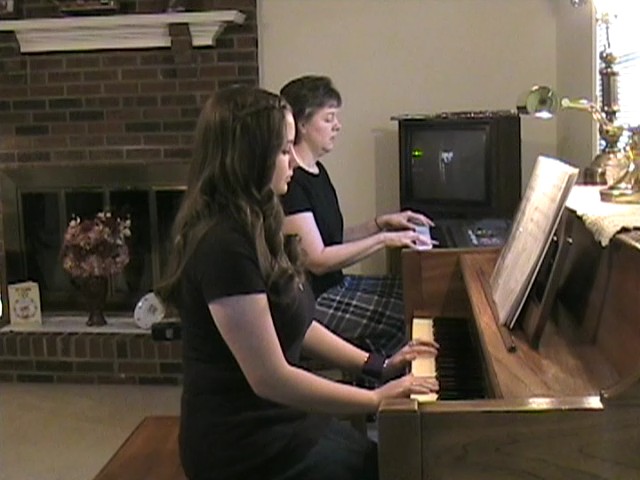
idea with you… with their video. Links to music included below the video.


Haven of Rest part one
Haven of Rest part two
Haven of Rest part three

The Church Pianist: Congregational Singing

Tuesday, March 2nd, 2010

Some hymns can be tricky for the church pianist when accompanying congregational singing. One such hymn is “Christ the Lord is Risen Today”.  This hymn has a busy rhythm!  Trying to play every note or word will cause a sluggish tempo or overworked tone.  

The remedy…don’t play every note/word.  The church pianist’s main concern is to play/outline the main beats of whatever time signature is represented. “Christ the Lord is Risen Today” is written in 4/4 time.  Therefore…play on beats one, two, three and four (no in between beats are necessary).  Adding a few in between beats here and there does add spice to the music though.

Since hymns sung during congregational singing are usually familar…I will stray from the melody here and there to add spice; encouraging the audience to sing with even more fervency!  Simply lose yourself in the meaning of the words to bring out creativity you didn’t think existed!  I’m always exhausted after playing for congregational singing…feels like I’ve run a marathon:)

To help   your creativity…I’ll provide an excerpt from the congregational arrangement of “Christ the Lord is Risen Today”.

Editor notes for today’s excerpt: I transferred alot of the  action to my left hand; where it was easier to add eighth note stepping octaves for spice. Occasionally I added sixteenth or grace notes to the right hand to keep it alive.(The full arrangement contains these  right hand additions.)

The complete congregational arrangement of “Christ the Lord is Risen Today” is available in the music store. 

Special Discount offer on this arrangement through the end of March.

The Church Pianist: The Lily of the Valley (free piano sample)

Saturday, January 16th, 2010

“The Lily of the Valley” is a nice, uplifting hymn. Several factors make this hymn a challenge for most church pianists.

The hymn is loaded with repeated notes and a very busy rhythm…(what I call….the “wordy” hymns).

You don’t want it to sound like you’re trying to chop down a tree 🙂

The church pianist needs to basically outline or (play) the main beats of the hymn. This particular hymn is in 4/4 time.   So…the pianist should at least play on the 1st, 2nd, 3rd and 4th beats…creating a steady, rhythmic  tempo for the congregation.

It’s not necessary for the pianist to play “every word” of the song when accompanying. Playing every word would limit the pianist’s ability to improvise. 

The more familiar the congregation is with a hymn…the less dependent they are on hearing the melody.  This allows the  pianist more  freedom to stray from the melody…making it much easier to maneuver through the accompaniment.

Editor notes for today’s free piano sample of “The Lily of the Valley”

Notice the left hand plays the main beats (1,2,3,4) and the right hand skip words here and there for ease of movement.

Measure #3 (beats 3 through 4)  the right hand plays notes within the chord frame being used… “sweeping upward”…for a livelier sound.

Measure #4 (beats 1 through 4) the left hand begins with a dotted rhythm for a peppy tone and drives through with octaves to maintain tempo while the congregation holds the word “soul”.

Measure #4 (beat 4) into Measure #5…the right hand moves into middle range of keyboard for variety in location.

Click here for free piano sample of “The Lily of the Valley”

The Church Pianist: Benefits of Sightreading

Tuesday, January 12th, 2010

Do you struggle when trying to play a choir arrangement  for the first time?

You’re not alone. I remember in my younger years…taking all the choir music home with me and learning the pieces real well.

Sighteading can benefit the church pianist in many ways!

The more you sightread…the easier it becomes to read music.

My piano teachers advised me to sightread music within my reading capablity. Why? So I would feel comfortable wading through a song that I had never seen before…which would increase my confidence. It worked! 

Always look at the following things in an arrangement before playing for the first time:

1. Time signature

2. Key signature

3. Tricky rhythms

4. Accidentals

5. Now…play the piece at a slow tempo; allowing your brain to compute what’s on the page 🙂

6. Try to look at the music as much as possible while playing…only looking down for awkward moves.

Try sightreading at least two songs a day well within your reading ability. Remember…it must be songs you’ve never played before.

The hymnal would be a good place to start for those at the intermediate level. (Example: Faber Lesson Book 3B)

The Church Pianist: Do You Practice Enough?

Thursday, December 24th, 2009

If someone were to ask  me if I practiced piano like I should…I would have to say, “Unfortunately…no.”

The older I get…the less motivated I am to practice. Anyone else have this problem or would admit to it?  “smile”

I hear this confession quite often from other composers. We spend so much time writing that we don’t take time to just sit and play.

What really motivates me…is getting with other piano friends and playing duets and duos.

I find myself wanting to sharpen my sightreading and technique skills.

A piano friend of mine and I are planning to meet  once a month starting in January. We plan to do  alot of sightreading.

I’m also planning to play a concert in the spring with another one of my piano friends to keep me on my toes.

Playing for a smaller church requires shorter offertories. The majority of the challenging arrangements I’ve learned through the years are too long for our offerings. I find myself just playing something from the hymnal most of the time.

Playing simple offertories from the hymnal is fine but I need a challenge every now and then… so occasionally, I’ll play a longer arrangement.

Click each song title  below to see the short offertories available on this site…

Let the Lower Lights Be Burning

Hallejuah, We Shall Rise

My Saviour First of All  (I Shall Know Him)

Feel free to share some of your own motivating practice tips by clicking on “comments” below.

Sincerely,

Jenifer
The Church Pianist: Youtube pedal tip (Lesson two)

Monday, July 27th, 2009

All pianists want their playing to sound smooth. How you use the pedal can make a huge difference!

In this youtube video, I’ll demonstrate the use of a pedal technique that I call the “pedal flutter technique”.  Hope it’s a help to some of you.

http://www.youtube.com/watch?v=OLZKMXjOSs0

The Church Pianist: Youtube Pedal tip (Lesson One)

Monday, July 27th, 2009

Does your piano playing ever sound choppy or cloudy and you just can’t figure out why?

Here’s a sh0rt youtube video clip… introducing a pedal tip to help revolutionize the sound of your playing!

Lesson two of this article on youtube, will include a demonstration for this pedal tip.

 http://www.youtube.com/watch?v=jvsf6Wt1RfA

Search Site
Article Categories