The Church Pianist: Transposing Hymns: The Easy Method

June 3rd, 2009

Transposing can be easy when moving a half step
higher or lower from the original key.

(This may be common knowledge to most of
you all but here’s to those who’ve never heard.)

First…you’ll need the music in front of you: preferrably the hymnal.

All you have to do is play the same notes, but in a different key.

For example:

A hymn in D major (two sharps) can be changed
to D flat major (five flats).

You’re reading the same notes but having to flat
certain ones instead of sharping them.

A hymn in A major (three sharps) can be changed
to A flat major (four flats).

Notice a numeric pattern? The sum of each key
change equals seven.

Also take note that each key maintains the same
letter name but moves from sharps to flats or vice
versa…depending on which direction you want to
transpose.

This is one of the easiest ways to transpose!

The Church Pianist: Wedding Music Resources

May 2nd, 2009

How many of you play for weddings at your
church?Do you ever have a hard time coming up with
music to play for weddings?Here are two books that have nice selections for
vocal specials and prelude music.Book title:

We Will Serve the Lord by The Wilds

Book title:

World’s Greatest Wedding Music (Easy Piano)
(50 of the Most Requested Wedding Pieces)
Selected and arranged by Dan Fox (Alfred Publising Co.)

The Church Pianist: Accompanying the Vocalist (Youtube video)

April 27th, 2009

Today, I’ll share a video of me accompanying
one of my voice students… Chesney… singing
“Trust and Obey”.

Hopefully, you will be able to observe some of
what I’ve discussed in other articles regarding…
accompanying the vocalist. Please excuse the loud
piano:(

Related links:

http://thechurchpianist.blogspot.com/2008/12/church-pianist-accompanying-vocal.html

http://thechurchpianist.blogspot.com/2008/10/church-pianist-improvising-tips-for.html

I do use some melody here and there in the
accompaniment.

Listen for the altered vii diminished chord in
the last verse. What word did it occur on? 🙂

Related article discussing the altered vii diminished chord:

http://thechurchpianist.blogspot.com/2009/01/church-pianist-stately-chord.html

Youtube link for video of Trust and Obey:

http://www.youtube.com/watch?v=vNfKYhQJe-A


The Church Pianist: Need More Practice Time?

February 23rd, 2009

Anybody need more practice time besides myself?

Our pastor had an excellent idea that has provided more practice time for our church pianists.
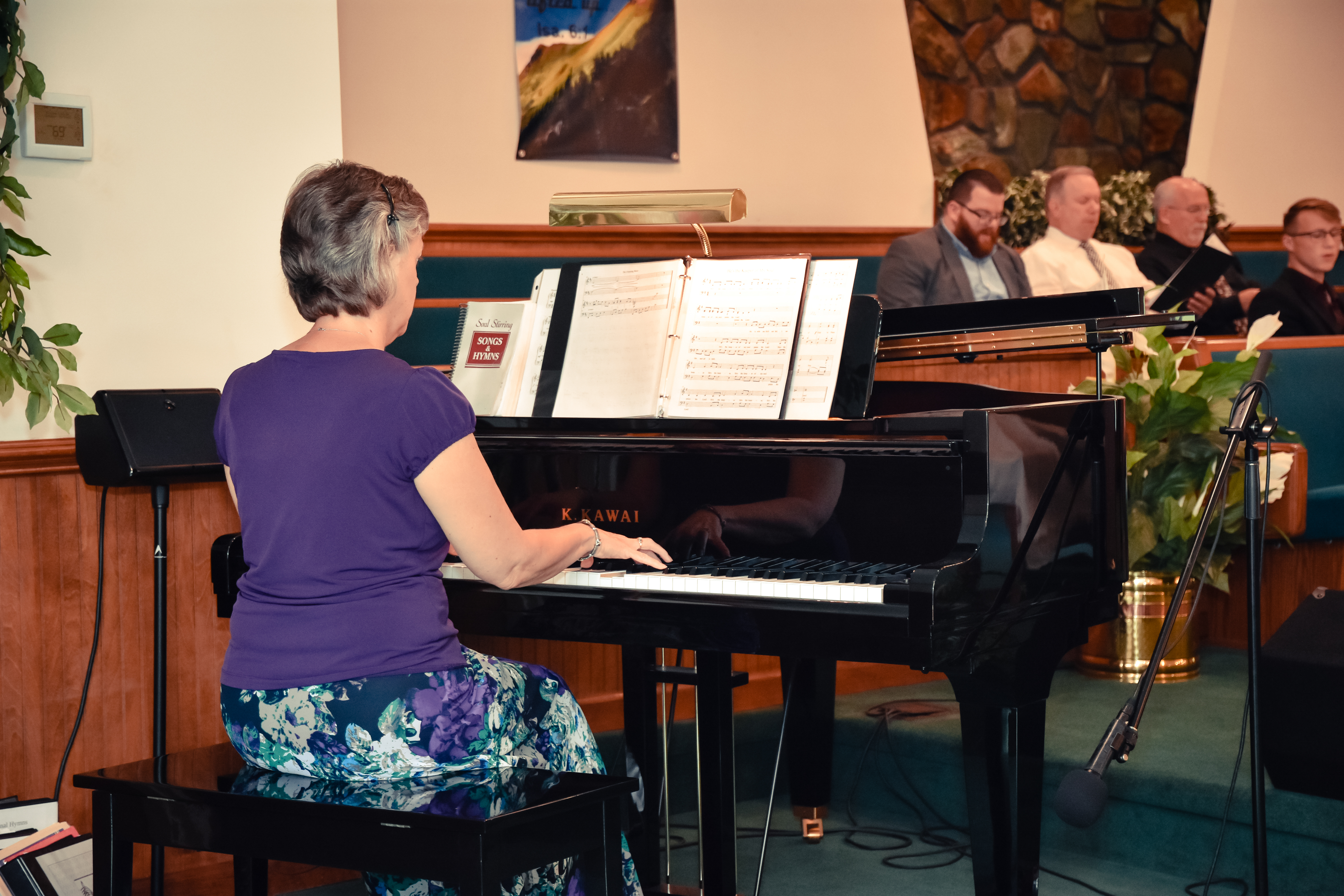
If you’re like most pianists, you’re usually practicing with someone before the service starts.

Our pastor had the sound man record offertories from our previous services on to one CD.

This CD is played before our services, giving us opportunity to practice or take care of lining up
future music during this time.

Approximately two minutes prior to the service, the CD fades out and I finish playing the prelude, which
acts as a good alarm clock for the choir, songleader and pastor to get in their places.

Need more practice time? Try this out. It has worked wonders for us. I find myself much more relaxed having
this extra time available.

The Church Pianist: Classical Music Benefits Church Pianists?

February 19th, 2009


Classical Music….a help or hindrance to the  church pianist?

A good question!

The answer is “Yes”…..classical music greatly benefits the church pianist!

How?

Advantages of being exposed to classical music:

*Conditions the ear for well-structured melodies and rhythm.

*Strengthens the fingers

*Demands a need for structured fingering which carries over into proper fingering for hymn arrangements.

*Introduces the pianist to scales and other rhythmic patterns in music that can be incorporated into the
  hymns as well.

*Last but not least….classical music demands disciplinein the areas of technique and interpretation for the
  best results.

Although classical music is vital to all pianists, the church pianist needs a balance of both: classical and hymn training.

I’m thankful for the teachers God provided for me in my early years of training.

I learned alot of improvising by just listening to the different teachers over the years. They also taught me ‘one on one’ how
to add runs and fill-ins. Most importantly, they taught me the theory to back up their training.

The Church Pianist: Amazing Grace Youtube Video

February 5th, 2009

I just posted a video on youtube playing a medley
of “Amazing Grace”.

For offertory, I’ll sometimes just play a hymn and tag on a
chorus or verse/chorus of a song with a similar theme.

Click on the link below to hear the “Amazing Grace” medley.

(Maybe it could help give you ideas
for doing one of your own.)

http://www.youtube.com/watch?v=94ATDkkMgus

The Church Pianist: No Time to Practice!

January 29th, 2009

When my kids were little, I found it hard to come
early or stay after services to practice with people.

My husband said, “Why not let them come to the
house during the week?”

Oh! (The most obvious) I’d never thought of that.

Practicing at our house turned out to be the best
experience for me and the singer or instrumentalist.

We were able to practice without interruptions; giving
us a chance to really focus on the music.

It was also easier to give helpful tips to the person in
a more private setting.

The person or persons felt more at ease in the less
crowded surroundings.

(My husband or family member of the person (s)
practicing would sit with my kids upstairs.

Time is precious. We just have to be creative about
finding more convenient niches of time to practice.

The Church Pianist: Youtube Video

January 13th, 2009

One of my blog guests asked if I would
post a video of me playing on youtube.

I borrowed a friend’s camcorder over
the weekend to make the recording.

This will give you an idea of my style.

The arrangement, Wonderful Peace, is one
I had published several years ago.

It’s available in sheet music at Soundforth (BJU Press).

http://www.bjupress.com/product/240895?path=1484

Youtube link:

http://www.youtube.com/watch?v=3LAshr2DqdQ

The Church Pianist: Free Christmas Piano Arrangement

December 19th, 2008

Click here for free arrangement of O Little Town of Bethlehem


The mood of a song determines what

type of accompaniment the pianist will  use.


“O Little Town of Bethlehem” is a soft

and peaceful Christmas carol…like a

lullaby.


If I were playing this as a piano solo,

I would use less fullness for a softer

texture. Since this was arranged  for the

congregation, the pianist will need

fuller chords for supporting a large

group of singers.


This particular Christmas carol has

frequent accidental or (altered) chords,

which can create awkward moves for

the pianist.

I tried to create an accompaniment

containing smooth harmonic movement

for the pianist.


Editor notes for: “O Little Town of Bethlehem”


Measure 3 :

I added the 7th note

to the ii chord (g minor) for a warmer

tone on the 3rd beat.

Measure 5:

The right hand plays a

fill-in on beats 3 and 4 for a smooth

transition to the upper range.

Measure 7:

Notice how I’m working

my way back down to the middle
range of the keyboard with my
right hand.

Measure 8:

I’m back to middle range
of keyboard to create a darker tone for
the words. (“….dark street…”)

Measure 13:

Bell tones (4th interval on

beats 2 and 3 to convey a “lighter” tone).

Please feel free to use this free piano

arrangement for congregation or choir.

You may adapt it to a piano solo with

minor changes.

The Church Pianist: Technique Tip

December 3rd, 2008

Ok…bounce a basketball and notice how your arm gives in to the bouncing motion (called…”follow through”).

Now…go to the piano and play several 4 note chords with your right hand.

Your hand and arm should give in to the weight of the initial force without a premature release.

So many pianists play full chords with a slap effect. They hit the chord and release, not giving the chord its full count.

What needs to happen is…attack and release.

The ‘attack’ is the initial force of playing the full chord.

‘Release’ means allowing the arm to rebound from the initial attack but not releasing the chord too early.

I call this the ‘Elmer’s glue’ touch. (Think of it as a delayed response).

Don’t be in a hurry to release the chords. Give them their full value.

This technique tip will prevent unnecessary strain on the hands and arms when playing songs with alot of full chording.

The music will also sound more musical and not so abrupt in tone.

~~~~Just relax and give in to the music! ~~~~~

Search Site
Article Categories