Archive for the ‘Theory’ Category

The Church Pianist: Playing be Ear

Thursday, November 20th, 2008

Playing by ear has its advantages and
disadvantages.

I confess, “I play be ear” but I also read
music.

My parents had me take lessons when I
was in third grade.

We moved several times during my childhood
years so I had several different teachers.

God blessed me with wonderful piano teachers.

Looking back, I can see how each one emphasized
certain concepts providing me with a well-
rounded diet of learning.

My learning involved these areas:

Improvising (adding runs, chord subsitutions)
I used the “Hymnplayer” series by Flora Jean
Garlock & Judy Swaim.

Theory

Classical music, Annual solo competitions
The competitions motivated me to practice
more because I had a purpose.

Learning to read music opened up a world of
opportunities!

I was then exposed to well-structured music,
which helped to tame my own style of playing.

Rhythm was one of my major weaknesses.

As a teenager, I began writing my own hymn
arrangements, exposing my own style and
rhythmic flaws.

I then became more analytical of my playing;
counting my fill-ins to make sure I had the
correct number of beats.

I also analyzed written arrangements of
various arrangers to learn ‘proper playing’.

‘Playing by ear’ is a gift but must be harnessed
with the reins of instruction for proper execution.

I would encourage those who ‘play by ear’ to
learn to read music and study theory.

I’m so thankful for my piano instruction. It has
given me the opportunity to share my heart
through written music.

Thanks Mom and Dad for making me practice!
The Church Pianist: How I Learned to Transpose

Tuesday, July 1st, 2008

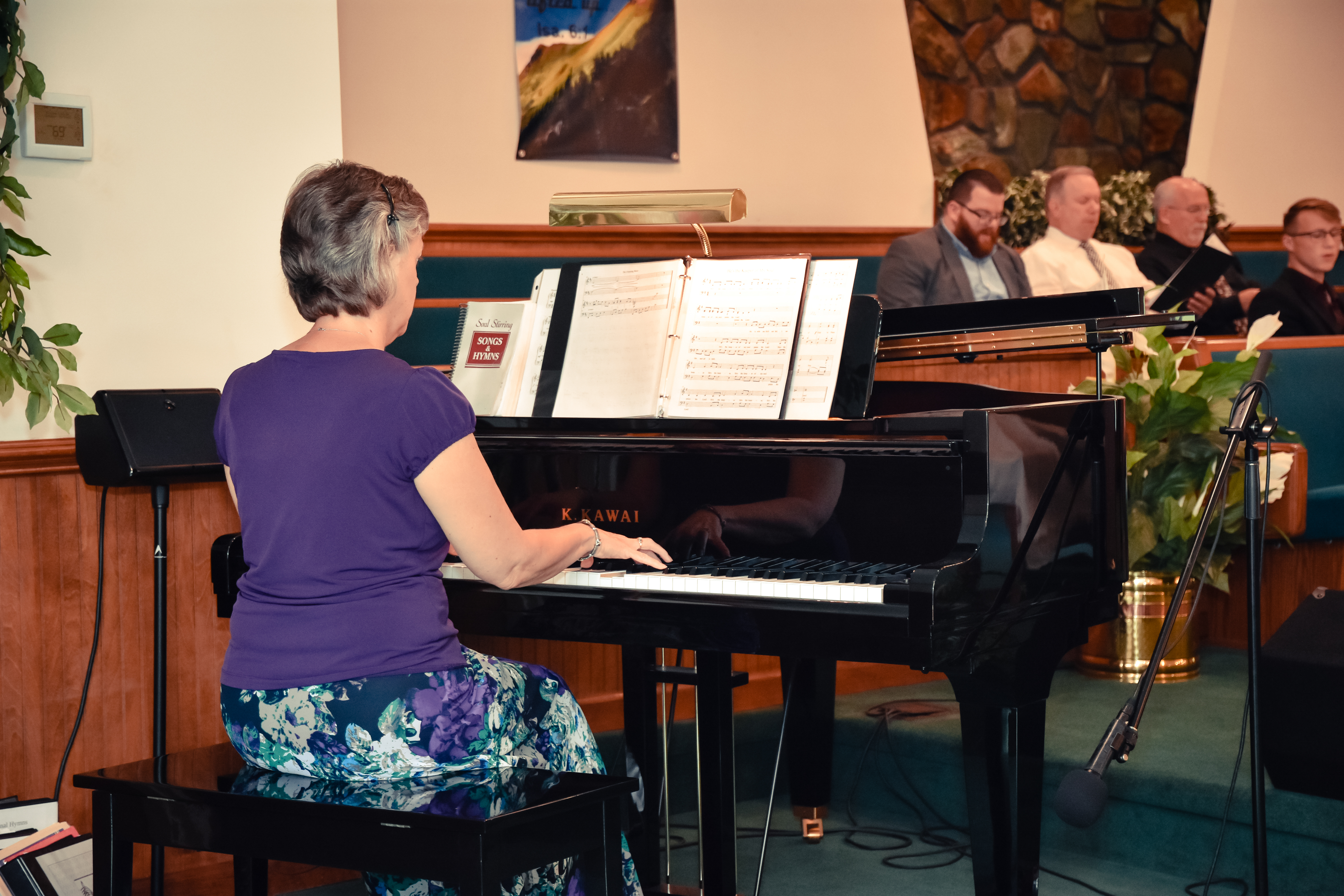
Transposing can be learned by the
church pianist but requires frequent
application to acquire confidence.

I do play by ear but my parents had me start
lessons at a young age so I would know how to
read music. Thank the Lord for that!

As a teenager I began to play for my dad to sing.
Prior to this, I had learned all the major scales
and played comfortably from the hymnal.

My dad is a bass so therefore I had to transpose
everything he sang!

Transposing a melody was easier if I already knew
how to play the song. The notes of the melody would
be the same distance apart but I would have to re-
member what was black.

Here was my thinking process:

Say, for example, the song was in G Major and
my dad wanted it in E flat Major.

E (flat) is three notes lower than G. I would just
think three notes lower for each melody note and
remember to flat the notes: E, A and B.

I always thought by chord numbers to transpose
for the left hand.

For example, the D chord in the key of G is the V (five)
chord because D is the fifth note in the key of G.
So, in the key of E flat….B flat is the fifth note….so
I would use the B flat chord in the new key.

Learning to transpose was a slow process at first but
I steadily grew more comfortable with constant practice.

See, I had no choice…I was my dad’s only pianist at
the time and had to learn.

Being forced into a situation does wonders for the learn-
ing process!

Challenge to the church pianist: Try transposing
a simple melody to several different keys.
Gradually add the left hand once you have a feel
for the melody in the new keys.

Search Site
Article Categories