Archive for the ‘Miscellaneous tips’ Category

Playing for Funerals

Saturday, April 6th, 2013

Flowers520

Playing for funerals is not the easiest task for a church pianist; especially if the deceased person was a close friend.  Over the past year, I’ve had to play at several funerals of people I knew very well.

God has given me the grace to make it through these funeral services. I like to play songs that comfort the family as well as myself.  I avoid too slow of a tempo on purpose…making it less of a sad tone and more bearable for the family.  Hymns with a medium tempo/mood such as Tis So Sweet to Trust in Jesus, He Hideth My Soul and Like a River Glorious are a few of what I call comforting tunes to play at such a time. Check out my piano funeral collection consisting of about 18 minutes playing time.

Several readers have emailed me lately asking for funeral tips.

Automatically I think of the prelude (music played before the funeral).  The length of the prelude can vary according to many factors.  For example, the last funeral I played for took place at a funeral home.  The family of the deceased person had many relatives that attended the viewing across the hall from the chapel.  The funeral home provided music over their intercom system during the viewing time.  We worked it out for me to start playing the prelude once the people started entering the chapel which was about twenty minutes prior to the service.

Playing for a funeral at a church can vary depending on if the viewing is held at the church or not.  At our church,  the sound man provides soft taped music in the background during the viewing and sometimes a little longer prior to the service;  to avoid having me play for an extended period of time.  The background music is just a collection of suitable recorded instrumental music from our church services.  I usually begin playing about 15 to 20 minutes before the service.

Unless you all do things differently,  the immediate family members start filing into the area of the funeral service right before time to start the service.  This is one of the most emotional times of the funeral.  I make sure I continue providing music during this difficult time to avoid an awkward time of silence. I finish playing when I see the last member of the family being seated or when the pastor looks at me and steps up to the pulpit to let me know he’s ready…whichever comes first.

Once again, at the end of the service, I begin playing when the family begins to exit and continue until the majority of the crowd disperses.

Some pianists have asked me where to expect the soloist(s) to sing.  Depending on the order of service, the special music can be placed just about anywhere. Here are  the different places I’ve seen vocal specials during a service:  at the beginning after family members are seated, after an initial welcome and remarks from pastor, after pastor’s message, after a prayer, for the conclusion of the service (especially if it was a favorite song of the deceased person).

Playing for a funeral service is the church pianist’s opportunity to minister to  both family and friends during a difficult time through God’s gift of music.


Music Storage

Tuesday, January 29th, 2013

Storage-cart-for-music

I’ve got to organize my music!  Currently, all of my music is stashed away in our front living room closet in a two drawer file cabinet and several boxes.  I plan to replace the boxes with two plastic drawer carts from Walmart.

I will store my piano books in the two-drawer file cabinet due to their heavier weight.   The sheet music will be filed away in the plastic drawer carts.

I’ve also thought about filing my own arrangements (sheet music) in labeled notebooks by category such as: Christmas, Wedding, Offertories, Preludes, Vocal Solos, etc.)

What storage ideas can you share that would help the rest of us?  Feel free to share your comments at the bottom of this article and I will post them as I see them come to my email  inbox.

I do like the pocket storage idea that Laura Lowe, author of Lowe Piano Studio, shared on her blog. Since my piano studio is in the living room…I would probably hang the pocket storage in my closet along with my music.

Joy Morin of Color in My Piano Blog also has a great idea with a simple bookshelf…

The Church Pianist: “Page Turns”

Tuesday, October 2nd, 2012

If you are a church pianist or play specials in the church service…you know what it’s like to turn pages while playing an offertory or choir special.

You (maybe) can get by with page turns for a choir special… but not for an offertory.

How to turn pages without disrupting the flow of music?  Two solutions come to mind that I have used:  Find someone to turn pages or turn your own pages using the following tips:

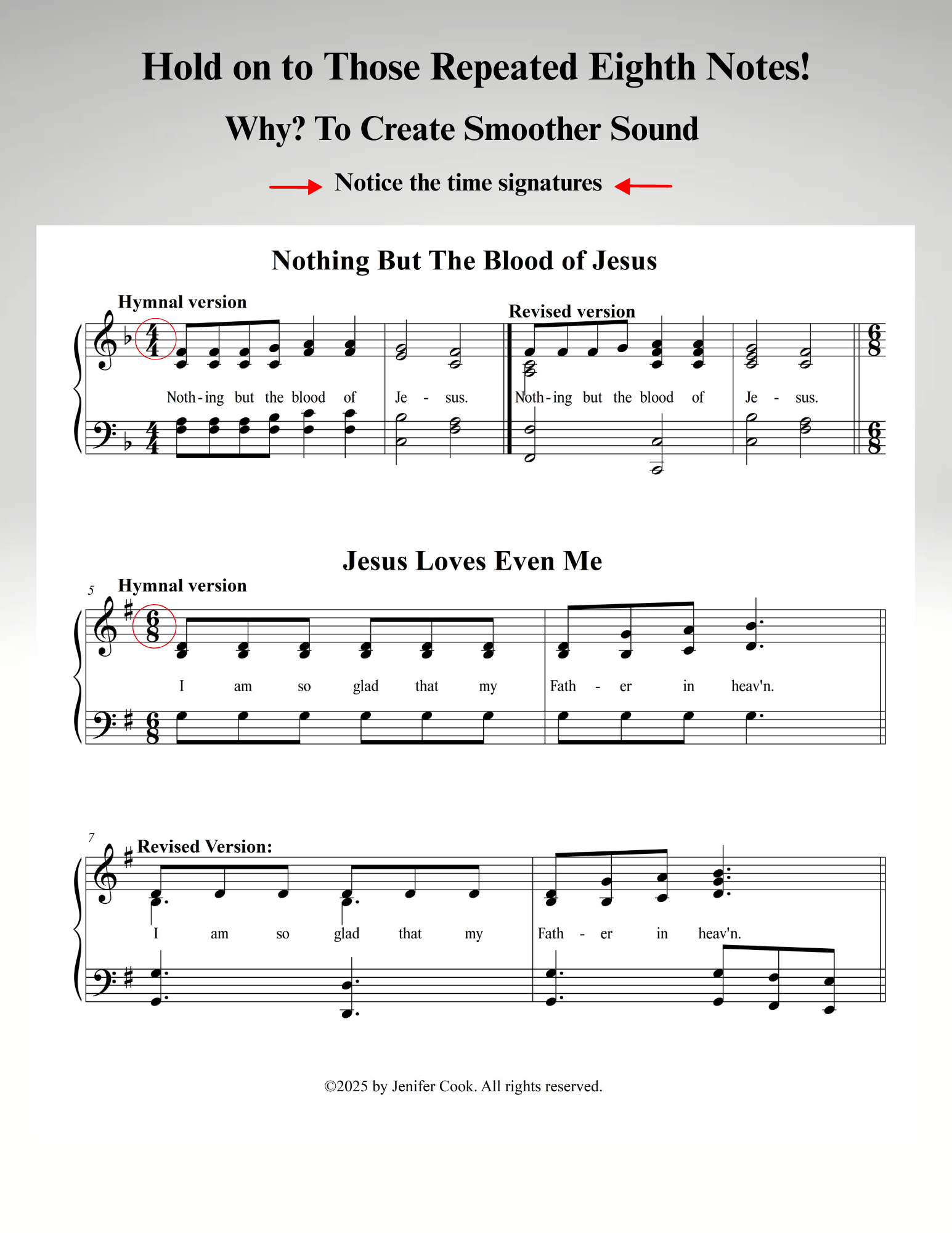
1.  Memorize a few measures before and after the page turns (very helpful!)  Tip: Try highlighting the measure where you pick up reading after a page turn to avoid disorientation  :)   Depending on the note content…it may be too tricky to turn a page a few measures before.  In that case, I memorize a little more so I can turn the page at a more convenient spot.

2.  Turn the page(s) with the hand that’s not playing the melody to maintain a logical flow

Face it…you may just have to miss a few notes with the non-melody hand to make this happen.

3.  I also turn back the corner of each page…making the page easier to grab

*I have copied pages to avoid page turns but ONLY with special permission from the publisher; so as not to infringe on copyright laws.  (I should probably devote an article on copyright laws).

If I have someone turn pages…I have them stand on my left side if at all possible…. so as not to block the congregation’s view of the person playing.

For those of us who’ve ever had “page turn” issues…I recommend the following video.  I’m just glad the girls knew their parts real well…especially the girl on the left.


I couldn’t resist sharing the next gadget that would be heavenly for any pianist!


Click here to visit Airturn, Inc. site


Fingering Tip for The Old Rugged Cross (free piano arrangement)

Friday, August 3rd, 2012

One of my church pianist readers recently asked me for some help on measures 29  and 30 of the free piano arrangement for “The Old Rugged Cross”.

In measure #29…The right hand has to reposition on the second beat in order to compensate for the upcoming busy movement.  I created a quickie video demonstrating a suggested fingering to make this area feel more comfortable to the hand.

Feel free to ask for any guidance or tips on this piece or any other arrangements I’ve written.

Glissando Tips

Tuesday, May 22nd, 2012

One of my church pianist readers recently requested that I provide some helpful tips on how to play glissandos.

One of the trickiest technical moves in my How Great Thou Art  piano arrangement is the glissando found on page four.   (Shown below)

How-Great-Thou-Art-glissando-section

Glissando Tips

1.  Notice the  three tenuto (line marks) under the left hand in measure 29.  These marks are pointing out the melody for the words “…then sings my…”.  Emphasize the melody and keep the glissando volume in the background (little softer than left hand).

2. The right hand begins the glissando with the index finger immediately after the left hand plays the G octave with the first tenuto (line) mark.  (It happens to be the same G as the left thumb just finished playing in the G octave).

3. Start the glissando with your right hand index finger…flipping the right hand over after the index finger starts.  The index finger and 3rd finger will glide across the keys in an upside down, horizontal position.  Once the index finger begins…the third finger will carry the brunt of the notes as you glide upward.  The index finger will act more as a support and guide for the third finger.  Just remember….the third finger is longer so it naturally has better contact of the keys.

4.  Word of caution to church pianists:  Glide across keys in a lightweight; relaxed fashion to avoid sore fingers :)

Visual Tips for the Glissando in How Great Thou Art


Following the Leader

Tuesday, February 21st, 2012

Following the song director is a challenge for a lot of church pianists.  Since I’m ancient…and have memorized the majority of the hymnal…I’m more free to look away from the hymnal and watch the director.

Seriously,  the church pianist must learn the hymns well enough  in order to  look away from the music at the song leader or at least have the leader’s arm  within your peripheral vision.

How does the pianist get comfortable playing “by feel”?  Try playing a familiar song in the dark.  I’m serious!  Playing in the dark is an excellent way to sharpen your senses/skills…just as a blind person may have a more keen sense than the average person because they are avidly “tuning in” to the situation at hand.

At least ten years ago…I was playing the prelude  in the Charlotte coliseum at a teacher’s convention.  It was right after 9/11.  All of a sudden, the lights went out!  A sudden rush of anxious, whispered voices stirred through the auditorium.  My thoughts…”Now what?!”

Thankfully I knew the hymns I was playing from “many” years of practice :)    The Lord just guided my fingers and I just played  soothing hymns to hopefully calm the concerned crowed (considering we had guards around due to the 9/11 event.  I remember hearing people singing along with several of the hymns.   A little over ten minutes went by before the lights came on.  It seemed like an eternity to me.

The Church Pianist: Improvising Tip

Wednesday, November 9th, 2011

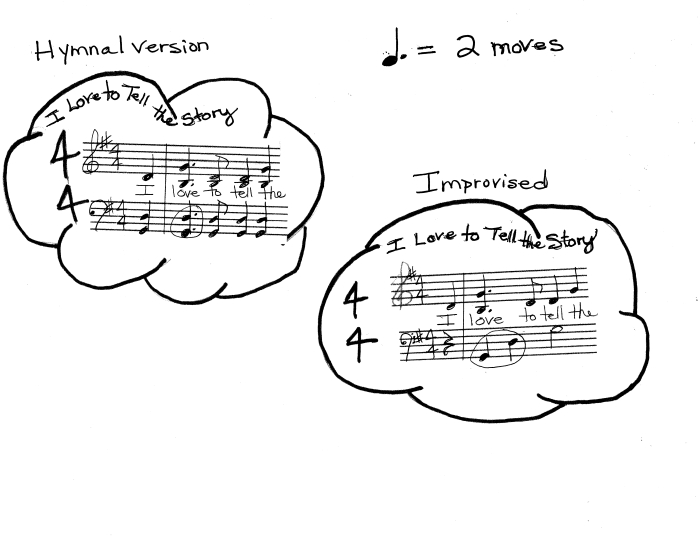
 Over the past ten years, I’ve learned ALOT of theory amidst many hours of  composing hymn arrangements.  There’s so much more I need to learn but I just pick up tips here and there and put them to use.  Now…I’ll share one of those tips with you.

The following improvising tip has made a difference in my hymnplaying; creating a more open, balanced sound.  I apply this tip to my congregational and solo playing.

The following hymn example contains “Come Thou Fount” in D major and the improvising tip.

Click here to download “Come Thou Fount” with improvising tip.

Just for fun: After playing  the above improvised example…add the 3rd of the chord in the right hand too…just to hear the difference.

The Church Pianist: Benefits of Learning to Read Music

Friday, November 4th, 2011
  1. Exposes the pianist to various styles of music helping to develop his own style over time.
  2. Teaches self-discipline
  3. Empowers the pianist to learn any song providing the pianist with a well-rounded diet of music.
  4. Opens many doors of opportunity to serve as an accompanist or soloist at various activities.
  5. Teaches one to play with correct harmonic and rhythmic structure if exposed to well-written music.
  6. Enables the pianist to express his own music in writing to share with others.


Improvising Hymns: Lesson Two

Sunday, October 9th, 2011

Click here to download worksheet before watching video for “Improvising Hymns” Lesson Two 

Have a pencil handy!

The following short video tutorial on improvising hymns is geared to the beginning church pianist.  Playing straight from the church hymnal can sound rather plain. Learning how to dress up the hymns adds a new dimension of sound! This lesson gives some simple left hand fill in ideas for the first line of “When I Survey the Wondrous Cross”.

Special clarification about the theory rule mentioned in this lesson concerning omitting the 3rd of the chord…The 3rd can be omitted from either hand.   Wait until you see the video below to understand this explanation :)

The next video tutorial will reveal more improvising ideas for “When I Survey the Wondrous Cross”.

Click here to see My First Improvising Lesson

Lesson Two: The II 7 Chord Substitution with Have Thine Own Way

Thursday, August 25th, 2011

Chord Scenario for this II 7  Chord Substitution:

When a I chord lasts for at least two beats and leads into a V or V 7  chord that lasts 3 or more  beats…the II 7 can replace a I chord.

On to our example in Have Thine Own Way in E flat major.  Since E flat is the first note in the key of E flat…it is number one. So F is the second note in the key of E flat major.  The ii chord would be: F-A flat-C.

Now let’s alter this minor ii chord by making it major.  Raise the middle note to A natural.  Are you beginning to catch on?  You now have the II  chord:  F-A natural-C   See illustration below:

Key-of-E-flat-Major-ii-7-and-II7-chord-visual*I added an E flat (not shown)… on the top of the II chord…making it a II 7 (the E flat is 7 notes from the bottom note (F).  Added 7ths make a chord sound SO much richer!

*You’ll notice the note members of the II 7 chord in the following excerpt are scrambled between both hands. The note “C” is missing (which is ok)… but the rest are present.

The-II-7-Chord-Substitution~   ~   ~   ~   ~   ~   ~   ~   ~   ~   ~   ~   ~   ~   ~   ~   ~   ~   ~

Now…a couple more examples of the II 7 chord substitution in the key of A flat & G Major.

~   ~   ~   ~   ~   ~   ~   ~   ~   ~   ~   ~   ~   ~   ~   ~   ~   ~   ~

Lesson Two (more II7 chord substitution examples)

   Special Note!

Are you wondering how to use the ii 7 chord in each example?  Whenever a V or V7 chord is lasting three or more beats…use the ii 7 chord first and then resolve to the written V or V 7 chord. I’ll share examples of this chord substitution in another article.  So much to share!

Church Pianist Tip:  Remember…chord substitutions can not be used during congregational singing unless they are singing unison. Why? Because the substitution chords will conflict with the voice parts.

Click here for: Lesson One: The  II 7 Chord Substitution