Archive for the ‘Chords’ Category

Chord Substitution: Adding minor 7th to a I Chord Before a IV Chord

Sunday, January 8th, 2012

Chord substitutions add color to hymnplaying! Here’s an easy chord substitution for church pianists to use.

Scenario: When a I chord is leading into a IV chord…add a minor 7th to the I chord. The minor 7th note is located a 7th above the root (bottom) note of the chord.  See the following explanation of the chords before viewing the free pdf sheet of this chord substitution.

Editor’s notes for free pdf sheet on this chord substitution:

Key of F:  I chord = F,A,C       IV chord =  Bflat,D,F    I chord with added minor 7th = F,A,C,E flat

Key of G: I chord =  G,B,D       IV chord =  C,E,G        I chord with added minor 7th = G,B,D,F natural

*Special note: The substituted chord ( I 7) does not have to contain all 4 notes as you’ll discover in the examples.

Click here to download free sheet for Chord-Substitution-adding-minor-7th-to-I-chord

Challenge yourself to look for the I (minor 7th)  chord already in use throughout the church hymnal.  Try applying the above chord substitution in other hymns during I – IV chord progressions. Tip: Use hymns with easy keys at first until you gain confidence with the concept.


Lesson Two: The II 7 Chord Substitution with Have Thine Own Way

Thursday, August 25th, 2011

Chord Scenario for this II 7  Chord Substitution:

When a I chord lasts for at least two beats and leads into a V or V 7  chord that lasts 3 or more  beats…the II 7 can replace a I chord.

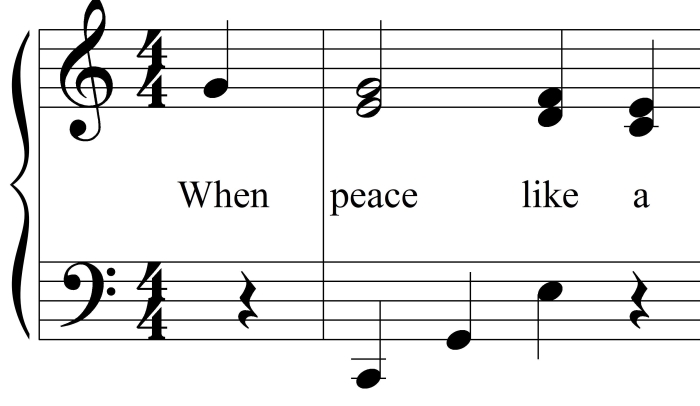
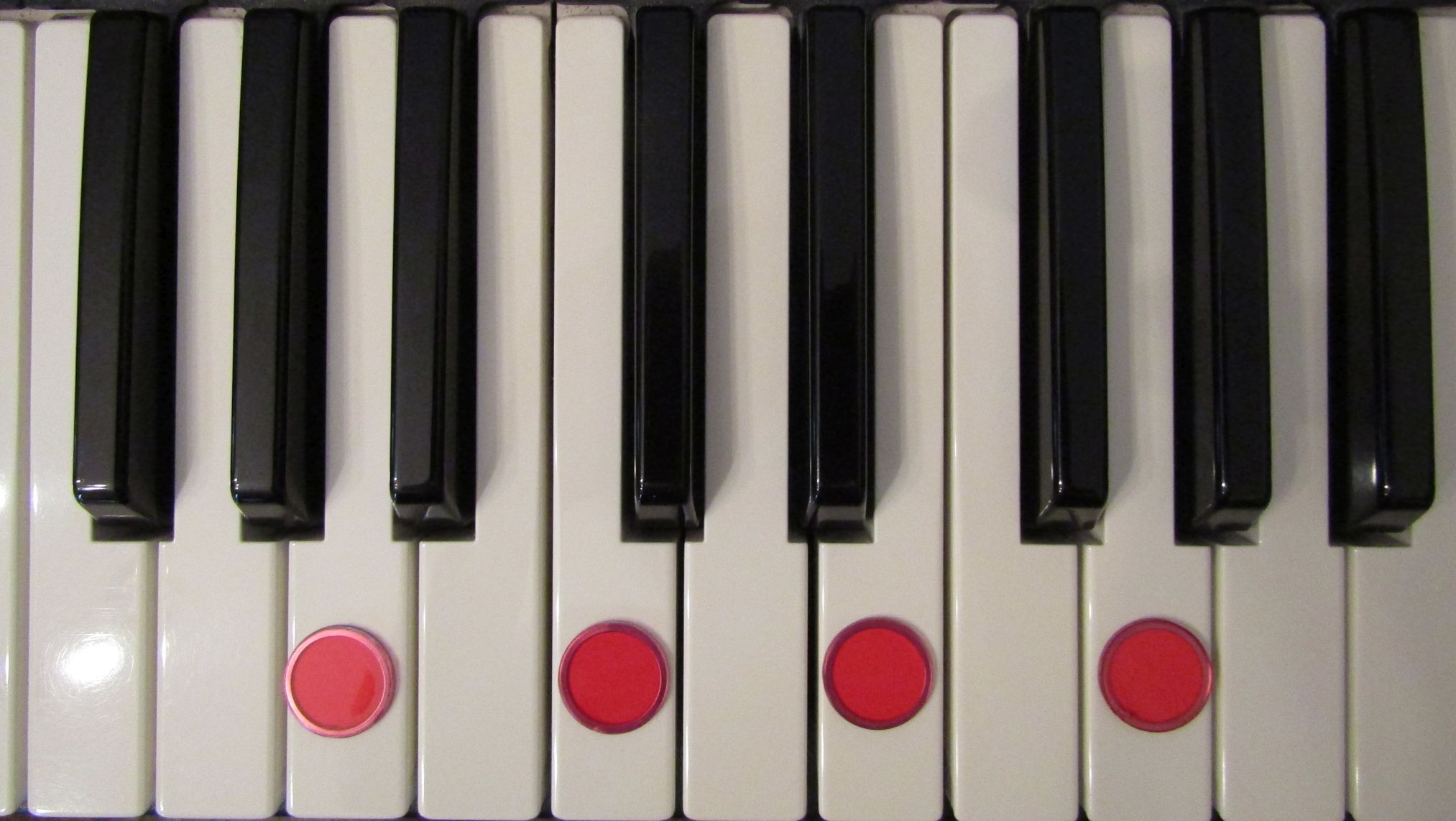
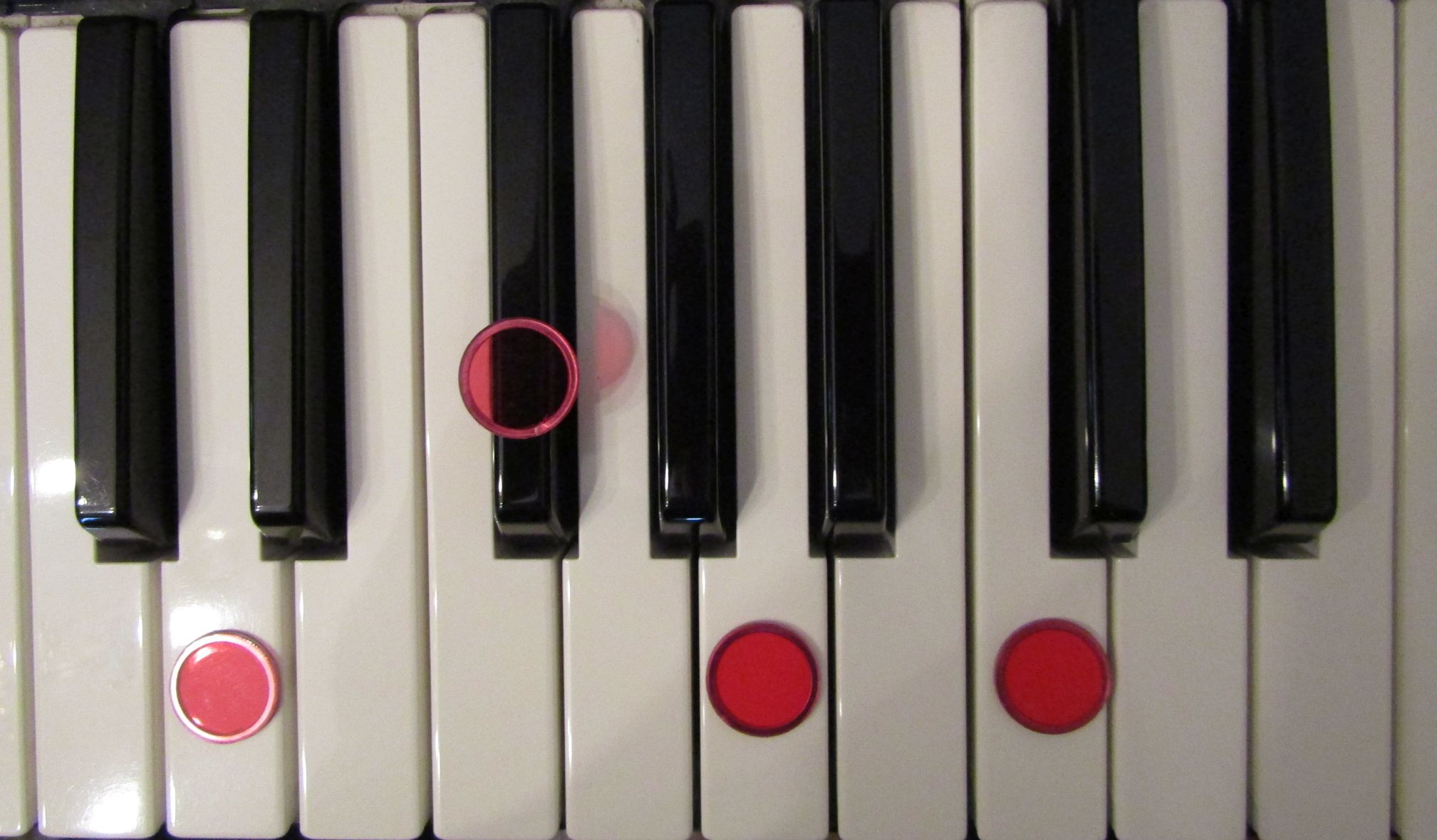
On to our example in Have Thine Own Way in E flat major.  Since E flat is the first note in the key of E flat…it is number one. So F is the second note in the key of E flat major.  The ii chord would be: F-A flat-C.

Now let’s alter this minor ii chord by making it major.  Raise the middle note to A natural.  Are you beginning to catch on?  You now have the II  chord:  F-A natural-C   See illustration below:

Key-of-E-flat-Major-ii-7-and-II7-chord-visual*I added an E flat (not shown)… on the top of the II chord…making it a II 7 (the E flat is 7 notes from the bottom note (F).  Added 7ths make a chord sound SO much richer!

*You’ll notice the note members of the II 7 chord in the following excerpt are scrambled between both hands. The note “C” is missing (which is ok)… but the rest are present.

The-II-7-Chord-Substitution~   ~   ~   ~   ~   ~   ~   ~   ~   ~   ~   ~   ~   ~   ~   ~   ~   ~   ~

Now…a couple more examples of the II 7 chord substitution in the key of A flat & G Major.

~   ~   ~   ~   ~   ~   ~   ~   ~   ~   ~   ~   ~   ~   ~   ~   ~   ~   ~

Lesson Two (more II7 chord substitution examples)

   Special Note!

Are you wondering how to use the ii 7 chord in each example?  Whenever a V or V7 chord is lasting three or more beats…use the ii 7 chord first and then resolve to the written V or V 7 chord. I’ll share examples of this chord substitution in another article.  So much to share!

Church Pianist Tip:  Remember…chord substitutions can not be used during congregational singing unless they are singing unison. Why? Because the substitution chords will conflict with the voice parts.

Click here for: Lesson One: The  II 7 Chord Substitution

Lesson One: The II 7 Chord Substitution

Wednesday, August 17th, 2011

A reader writes…

I’ve printed your “Have Thine Own Way, Lord”.  How did you know to put a F7 on the 2nd “own” in the first  full measure….
Is there a process of knowing what chords are to be uses as substitution and when to use them?
 
~Elise~
 

Fortunately…yes!  :)   There’s an endless supply of chord substitutions that can be used…depending on the initial chord scenario.

To begin with, I’ll apply this II 7 chord substitution to  the key of C Major for easier application. (Otherwise, it’s like teaching a beginner to play Moonlight Sonata at his first lesson)

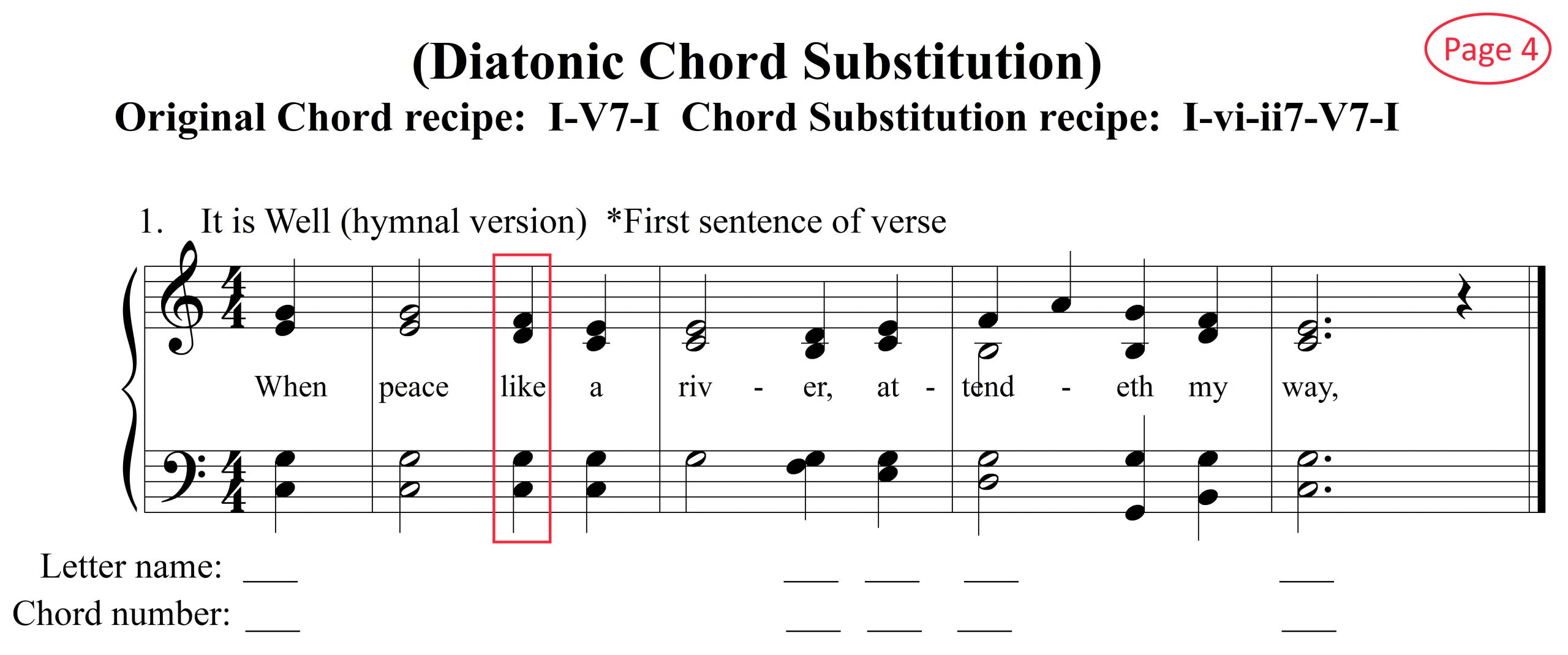
So…what’s a II chord?!  In simple terms…it’s an altered chord.  Normally, the second chord in any major key is a minor chord…thus marked in lowercase roman numerals…ii.  For example, in the key of C Major…the ii chord is D-F-A.  (D is the second note in the key of C Major which gives the chord its number).   But…we can alter the chord (making it a major chord) by raising the middle note of the chord (the note F to an F sharp). * See example below

Now…to create the II 7 chord…just add the 7th note above the bottom note of the chord.      *See Example below

C Major ( how to create the II 7 chord)

Chord Scenario for the II 7 Chord Substitution:

1. When a I chord lasts for at least two or more beats leading into a V or V 7 chord lasting two or more beats. (to allow time for chords to develop) I’ve used the II 7 chord with less beats but in general…it’s best to allow enough beats for chords to sound like they belong and not just randomly thrown in.

In the examples below, I’ve included the vocal and piano score to reflect the changes made in the piano accompaniment.  *Reminder: chord substitutions clash with congregational singing due to the note changes.

I use chord substitutions when playing solo offertories, background music for invitation, prelude/postlude, communion and accompanying a vocal or instrumental soloist.


Examples in C Major (II 7 substitution)

~  ~  ~  ~  ~  ~  ~  ~  ~  ~  ~  ~  ~  ~  ~  ~  ~  ~  ~  ~  ~

 In Lesson Two, I’ll share more examples of this II7 chord substitution… including “Have Thine Own Way”.

*Please feel free to ask questions.


Upcoming Article: Substituting the I Chord with the II7 Chord

Tuesday, August 16th, 2011

Have _Thine _Own_ WayA reader recently asked me how I knew to use a certain chord substitution in one of my free arrangements “Have Thine Own Way”.

My first answer would be…I just thought it sounded nice.  But…unfortunately that’s NOT the best answer.  I hope to explain it in such a way that the average church pianist can take and apply this chord  substitution on their own.

Looking forward to posting this article soon!

The Church Pianist: Chord Substitutions

Friday, February 26th, 2010

I know many church pianists already use chord substitutions but some  of you may not be sure what chords fit where.

Today, I was trying to show one of my hymnplaying students several chord substitutions for the last line of “Just As I Am”.  We were short on time…so I had her video me playing the chord substitutions so I could just email it to her.  The thought occured to me…maybe others could benefit from this very brief video demonstration of chord substitutions.

You may have to pause here and there to get a glimpse of  the chord substitutions. 

Editor notes for today’s quick video…

Scenario:  When the same chord lasts for an entire measure…it’s time to try a chord substitution for a more interesting sound.

For example…the last line  of “Just As I Am”…

“And that Thou bidst me…”  uses a C chord

Chord substitution used:  G minor 7th to a C 7

Next few words…

“…come to Thee O…”  uses a F chord

Chord substitutions used: F , d minor, G7

Next words…

“…Lamb of God, I come!”  uses a C to G chord

Chord substitutions:  a minor 7 on “God”  d minor 7  for  ”come”

Church pianists can revolutionize the sound of their  hymnplaying just by adding chord substitutions!

Now…for a quickie video, demonstrating these chord substitutions… 


The Church Pianist: Part Two (Augmented chord Substitution)

Wednesday, August 19th, 2009

The augmented chord does have a special symbol.

A plus (+) sign proceeds the chord name.

For example:  The C augmented chord would be labeled

this way:  C+

The augmented chord adds a nice upward movement effect

when used in the following scenario:

When a I chord lasts for at least one measure leading into a IV chord.

Substitute the I chord with an augmented chord usually at least

halfway through the measure.

Here are a few improvised examples.

Part_Two_Augmented_Chord_Substitution

Part_Two_Augmented_Chord_Sub_Example_3

Try this augmented chord subsitution on the following hymns:

Trusting Jesus ( “Simply trusting ev’ry day) on the word “day”

The Haven of Rest (“My soul in sad exile was….)  on the word “ex-ile”

Wonderful Peace (“Far away in the depths…”)  on the word “depths”

                                         *(Also in the chorus of Wonderful Peace)…

                                                    Can you guess where? (at least two places).

What is an augmentedchord?  http://thechurchpianist.com/category/chord-substitutions/

The Church Pianist: What’s an Augmented Chord?

Wednesday, August 19th, 2009

The word “augment” means to make larger.  That is exactly what happens

when a chord is augmented…it is made a half step greater.

The augmented chord adds a touch of “suspense or anticipation” to

a song.

An augmented chord is just like a major chord (in root position)

with a raised fifth.

For example:

The  C major chord in root position = C E G

The C augmented chord  = C E G#

Any major chord can be augmented within a song as long

as it sounds right.

Alot of hymns use the augmented chord. Here are two

brief examples.

Click here: Part_One_The_Augmented_Chord

Did you find the augmented chords in the above example?

If not, here are the answers: (There was only one in each example).

Moment by Moment: on the word “by”

Thank You Lord: on the word “for”

In part two, I will share how to use the augmented chord

as a  chord substitution in hymns.

Custom Search
  • Article Categories
    Store Discount!
    15% discount on purchases greater than $15. Use coupon code: FERMATA
    Christmas CD
    Simply Christmas CD *Available as hard copy